Paying Cash for a Used Car: What You Save With Loans at 11%
Used car loans average 11% right now. On a $20,000 car that's $6,091 in interest over five years, and $8,766 over seven. Here's what paying cash saves, what paying a loan off early saves, and when financing still makes sense.
 Mirko7 min read
On this page10 sections
The average used-car loan rate was 11% in October, according to Edmunds. Used-car buyers who finance borrow an average of $30,703, Fortune reported from Edmunds' third-quarter data.
At that rate, interest is one of the biggest costs of owning the car. To keep the math simple, every example below uses a $20,000 used car and rounds to the dollar.
What an 11% loan costs on a $20,000 car
| Loan term | Monthly payment | Total interest |
|---|---|---|
| 36 months | $655 | $3,572 |
| 48 months | $517 | $4,812 |
| 60 months | $435 | $6,091 |
| 72 months | $381 | $7,409 |
| 84 months | $342 | $8,766 |
Paying cash saves all of it. Stretching the loan from five years to seven lowers the payment by $93 a month and adds $2,675 in interest. To run your own price, rate and term, use our used car loan calculator.
Your credit score matters more than the term
11% is an average. Experian's second-quarter data puts used-car rates anywhere from about 6% for the best credit scores to about 22% for the worst. Here's the same $20,000 car over 60 months, with Experian's rates rounded:
| Credit tier | Rate | Total interest |
|---|---|---|
| Super prime (781-850) | 6% | $3,199 |
| Prime (661-780) | 9% | $4,910 |
| Near prime (601-660) | 14% | $7,922 |
| Subprime (501-600) | 19% | $11,129 |
| Deep subprime (300-500) | 22% | $13,143 |
At 22%, a buyer pays two-thirds of the car's price again in interest. That buyer saves the most by paying cash, or by buying a cheaper car they can pay cash for.
Cash beats leaving the money in savings
A common argument for financing goes like this: keep your cash in savings, earning interest, and borrow instead. That only works when your savings earn more than the loan charges.
Say you have $20,000 in savings earning 4%, and you can afford the $435 payment on a 60-month loan at 11%.
- Finance it. Your $20,000 stays in savings and grows to $24,420 over five years. You pay the loan from your income.
- Pay cash. Your savings drop to zero, but you put the $435 you would have paid the lender into savings each month instead. After five years you have $28,830.
Paying cash leaves you $4,410 ahead. As long as the loan rate is higher than your savings rate, the gap only grows with the loan term.
If you finance, pay it off early
Every extra dollar you put toward an 11% loan saves you 11% interest on it, guaranteed. Few savings accounts come close. On a $20,000, 72-month loan at 11% ($381 a month, $7,409 in interest):
| What you add | Interest saved | Loan ends |
|---|---|---|
| $50 a month | $1,234 | 11 months early |
| $100 a month | $2,107 | 19 months early |
| $200 a month | $3,265 | 30 months early |
| $5,000 once, after a year | $2,889 | 20 months early |
| $1,000 once, in the first month | $877 | 4 months early |
Paying the whole balance off after two years saves $3,544 of the $7,409. After three years it saves $2,077.
Two things to check first. Read the loan contract for a prepayment penalty. And when you pay extra, make sure the lender puts it toward the principal and doesn't just count it as an early payment for next month.
Before you message the seller
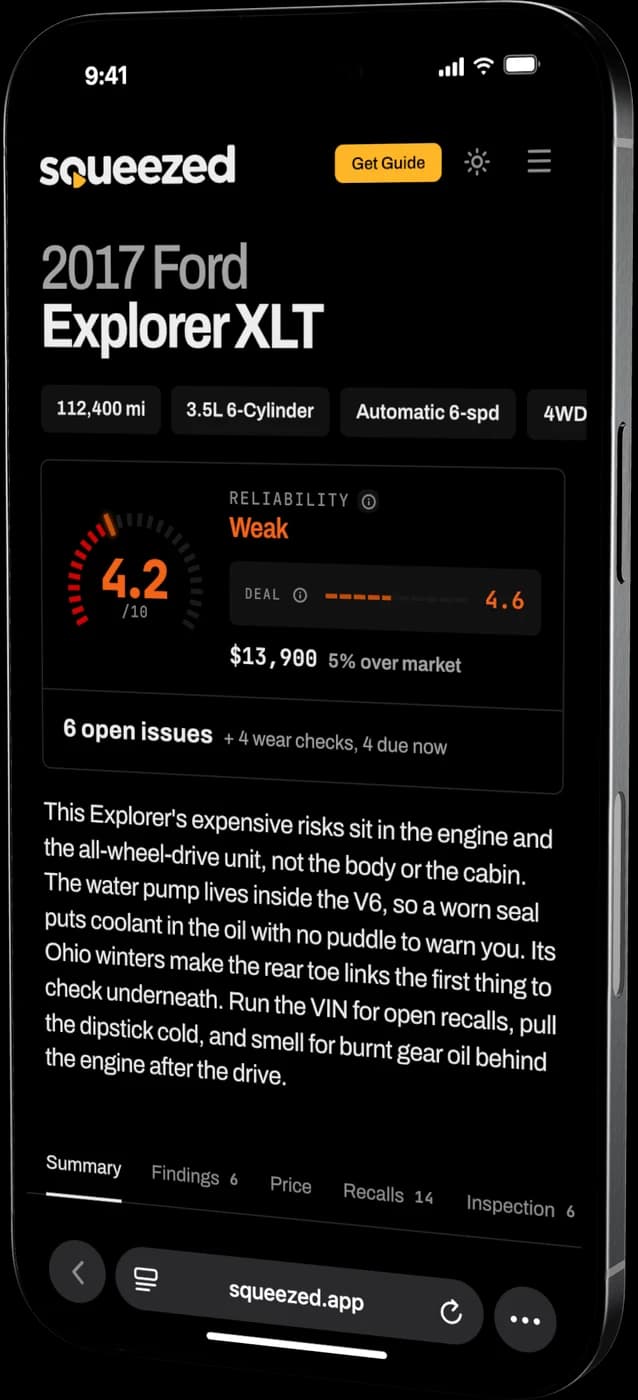
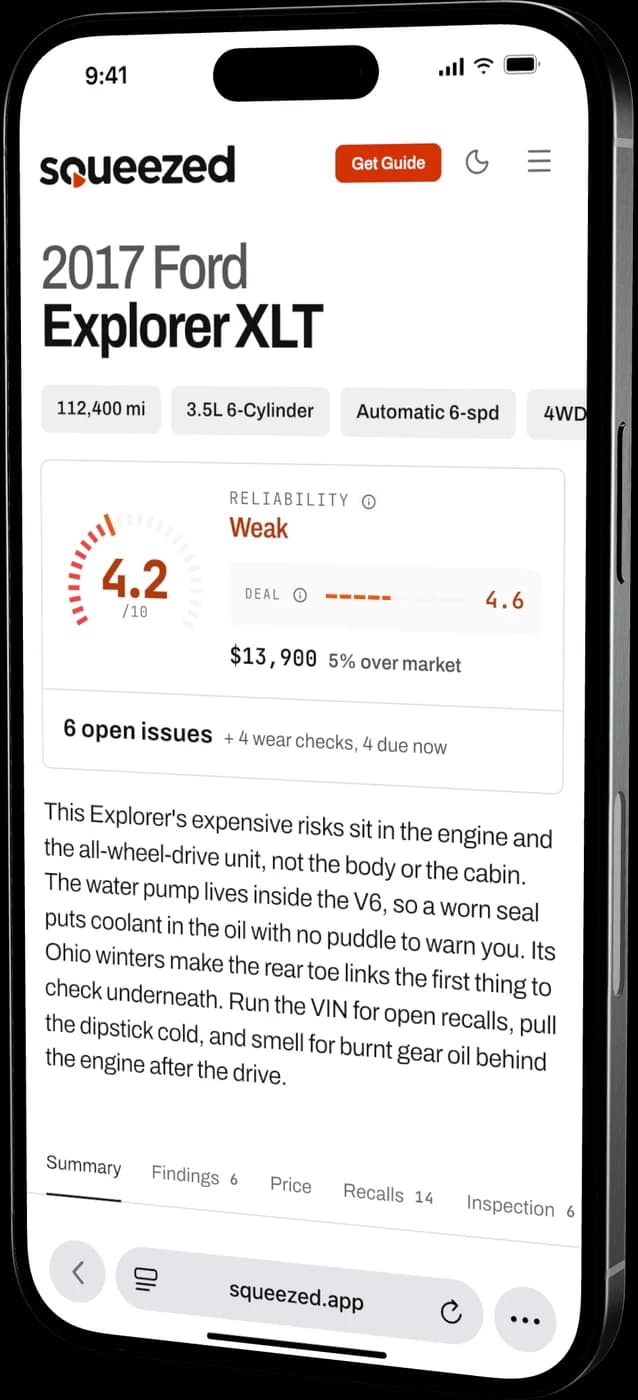
Say goodbye to surprise repair bills.
Search the car you’re looking at. In about a minute: known failure patterns, repair cost exposure, questions to ask the seller and an overall risk rating.
Use it before you book an inspection
The 84-month trap
One in four new-car loans now runs 84 months or longer: 25.5% in the third quarter, according to Edmunds. Long terms keep the payment low, but the balance barely moves for years.
On a $20,000, 84-month loan at 11%, after three years you've paid $12,328. You still owe $13,250. Only $6,750 of your payments went toward the car. The other $5,578 was interest.
If you sell or trade the car before then, you can owe more than it's worth. Among underwater trade-ins, the average negative equity hit $6,884 in the second quarter of 2026, CNBC reported from Edmunds data. About one in four of those trade-ins carried more than $10,000. That debt usually rolls into the next loan.
A cash buyer never has this problem. Whatever the car is worth, it's yours.
What else cash gets you
Any seller. Private sellers want cash or a cashier's check, and they often have the best-priced cars. Some lenders won't finance older or high-mileage cars at all, or charge more for them. With cash, the lender doesn't get a say. Our private-party buying guide covers how to pay a private seller safely.
A simpler negotiation. When you finance at the dealer, the talk turns to the monthly payment, which hides the price, the term and the rate in one number. A dealer that arranges your loan can also add a markup to the rate the lender approved. A cash buyer only negotiates the price. Our guide to negotiating with repair costs shows how to bring it down.
Cheaper insurance on an older car. A lender requires comprehensive and collision coverage until the loan is paid off. With no loan, you decide. On a car worth a few thousand dollars, dropping that coverage can make sense.
No add-ons. No GAP insurance, no loan fees, and no monthly payment if you lose your job.
When financing still makes sense
- The rate is lower than your savings rate. Some certified pre-owned programs advertise rates under 2%. At that rate, financing and keeping your cash invested can come out ahead.
- Paying cash would empty your emergency fund. A car bought with your last dollar is a problem the first time something breaks. Keep a repair reserve on top of the price. Our post on the hidden costs of owning a used car covers how much.
- You can only pay part of it. A big down payment gets most of the benefit. On the $20,000 car over 60 months at 11%, putting $5,000 down cuts the interest from $6,091 to $4,568, and $10,000 down cuts it to $3,045.
If the car you can afford in cash is cheaper than the one you can afford on payments, the cheaper car often wins. You can save the payment you're not making and upgrade with cash later. The loan calculator finds that cheaper price for you.
Final thoughts
At 11%, a $20,000 used car costs $26,000 to $29,000 on payments. Paying cash, paying a big part of it up front, or paying the loan off early are the cheapest ways to own the car.
Paying cash also means no lender and no bank inspection, and nobody but you checking the car. This is the research you do before you make an offer. Run a Squeezed report on the car you're looking at. It takes 45 seconds and costs less than a tank of gas.
Sources
- Edmunds, Car Loan Rates (APR) for Used and New Cars (October 2026 used-car APR, 11%)
- Fortune, Car payments just hit a record $787 a month (October 14, 2026, Edmunds third-quarter data)
- Experian, The Latest Used Car Loan Interest Rates for 2026 (second-quarter 2026 rates by credit tier)
- CNBC, The growing problem of "permanent car loans" (September 30, 2026, Edmunds negative equity data)
- Loan math: standard amortization on a $20,000 loan, monthly compounding, rounded to the dollar. The savings comparison assumes a 4% savings rate.
FAQ
How much interest will I pay on a $20,000 used car loan?
At 11%, the average used-car rate in October 2026 according to Edmunds, a $20,000 loan costs $6,091 in interest over 60 months, $7,409 over 72 months and $8,766 over 84 months.
Is it better to pay cash for a used car or finance it?
Usually cash, when the loan rate is higher than what your savings earn. With a loan at 11% and savings at 4%, paying cash for a $20,000 car and saving the payment instead leaves you about $4,400 ahead after five years. Keep an emergency fund and a repair reserve either way.
How much do I save by paying off a car loan early?
On a $20,000, 72-month loan at 11%, an extra $100 a month saves about $2,100 in interest and ends the loan 19 months early. An extra $200 a month saves about $3,300 and ends it 30 months early.