Every 3rd Gen Escape year compared
| Year | Verdict | Major problems | Complaints | Recalls |
|---|---|---|---|---|
| 2013 | n/a | 1 | n/a | n/a |
| 2014 | n/a | 1 | n/a | n/a |
| 2015 | n/a | 1 | n/a | n/a |
| 2016 | n/a | 1 | n/a | n/a |
| 2017 | n/a | 2 | n/a | n/a |
| 2018 | n/a | 2 | n/a | n/a |
| 2019 | n/a | 2 | n/a | n/a |
Owner complaints and recalls are from NHTSA. A year is marked to avoid when it has a critical problem the rest of the generation does not, or at least twice the generation's complaint rate once its age is taken into account. Years less than three years old are too new to judge. n/a means NHTSA has no data for that year.
Known problems on the 3rd Gen Escape
- Critical · deal-breakers
- Major · costly soon
- Caution · keep an eye on
- OK · low concern
2.0L EcoBoost
- CriticalAll years$4,500 – $8,000
Coolant Intrusion into the Cylinders
Some 2015 to 2019 engines leak coolant into the cylinders, and Ford's fix is a replacement engine.
- CautionAll years$400 – $900
Carbon Buildup on Intake Valves
Fuel is injected straight into the cylinder, so nothing washes the intake valves and carbon builds up on them.
1.5L EcoBoost
- Critical2017-2019$4,500 – $8,000
Coolant Intrusion and Overheating (Recall)
Coolant can leak into the cylinders, causing white smoke, misfires and overheating, and the usual fix is a new short block.
About the 3rd Gen Escape
The 2013-2019 Ford Escape is the third generation and moved the model onto Ford's global C platform, making it a close relative of the European Kuga and a substantially different vehicle from its predecessor. Engines were a naturally aspirated 2.5-liter four-cylinder and turbocharged 1.6-liter and 2.0-liter EcoBoost units, replaced by a 1.5-liter EcoBoost during the run, all paired with a six-speed automatic. Front-wheel drive was standard with all-wheel drive optional. A significant facelift for 2017 revised the front end and interior.
The new platform gave the Escape much sharper handling and a more car-like driving position than the boxy vehicle it replaced, along with a hands-free power liftgate that was a novelty at launch. Cargo space was reduced relative to the previous generation as a consequence of the more raked body. The fourth generation that followed in 2020 softened the styling again and added hybrid options.
As a used buy, powertrain choice matters more here than in most crossovers. The 1.6-liter EcoBoost was subject to recalls concerning coolant intrusion into the cylinders and associated overheating and fire risk, and its history on any specific vehicle should be verified. The 2.0-liter EcoBoost is the stronger and generally better-regarded turbocharged option. The naturally aspirated 2.5-liter is the simplest and least troublesome but is noticeably slower. Post-2017 examples benefit from the interior and infotainment update.
Other Ford Escape generations
Free Car Finder
Still deciding on the Ford Escape?
Answer a few quick questions and see your top 3 used cars, with the years to shop.
Before you message the seller
Say goodbye to surprise repair bills.
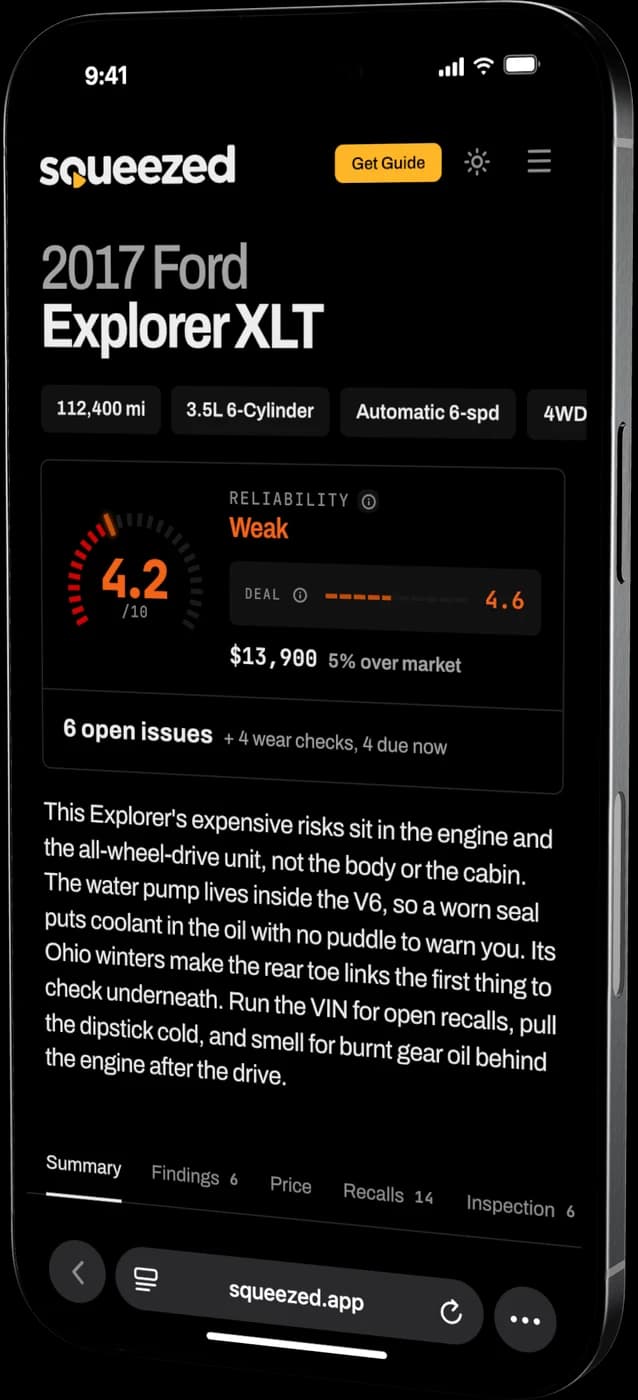
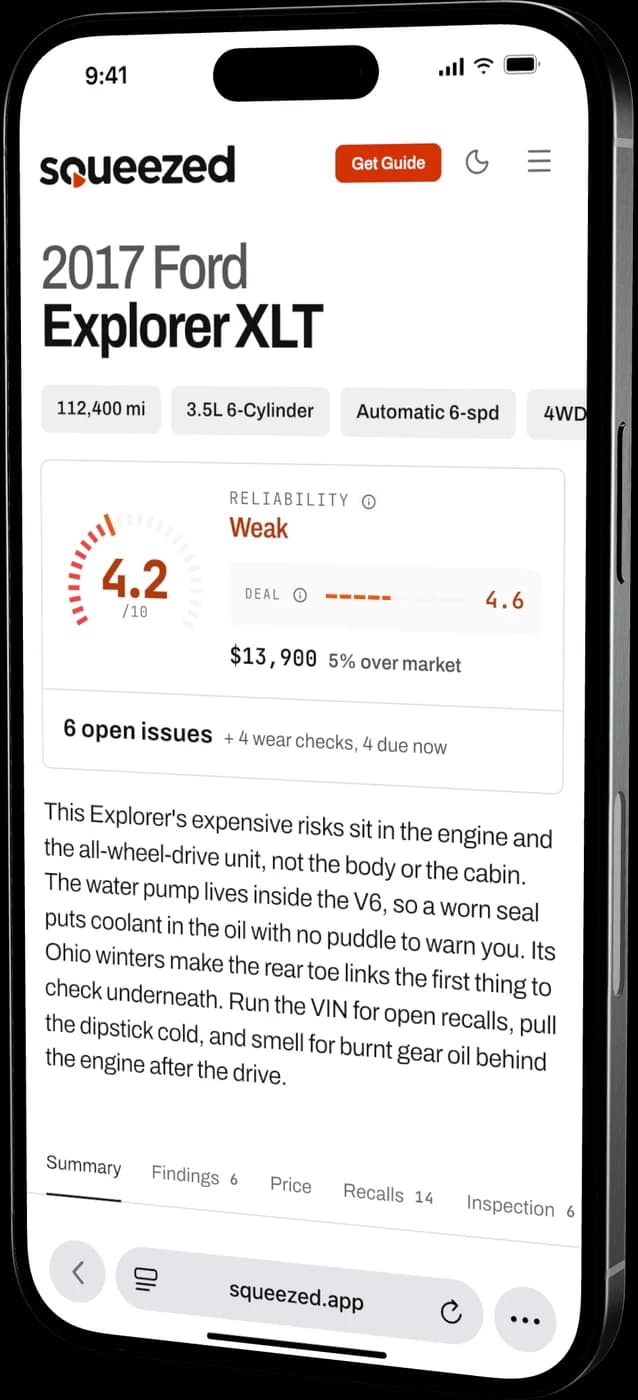
Search the car you’re looking at. In about a minute: known failure patterns, repair cost exposure, questions to ask the seller and an overall risk rating.
Use it before you book an inspection
Squeezed is a buyer guide based on public data and industry patterns, not a mechanical inspection. Always get a professional pre-purchase inspection before you buy.