Every 2nd Gen Rogue year compared
| Year | Verdict | Major problems | Complaints | Recalls |
|---|---|---|---|---|
| 2014 | n/a | 2 | n/a | n/a |
| 2015 | n/a | 2 | n/a | n/a |
| 2016 | n/a | 2 | n/a | n/a |
| 2017 | n/a | 2 | n/a | n/a |
| 2018 | n/a | 2 | n/a | n/a |
| 2019 | n/a | 2 | n/a | n/a |
| 2020 | n/a | 2 | n/a | n/a |
Owner complaints and recalls are from NHTSA. A year is marked to avoid when it has a critical problem the rest of the generation does not, or at least twice the generation's complaint rate once its age is taken into account. Years less than three years old are too new to judge. n/a means NHTSA has no data for that year.
Known problems on the 2nd Gen Rogue
- Critical · deal-breakers
- Major · costly soon
- Caution · keep an eye on
- OK · low concern
- CriticalAll years$3,000-4,500
CVT Belt Wear / Failure
CVT8 transmission can develop belt slip, shudder, or complete failure. Nissan extended warranty on 2014-2016 models. Regular fluid changes (every 30k miles) are essential. Symptoms: hesitation, whining, shudder under acceleration.
- MajorAll years$2,500-4,000
QR25DE Oil Consumption
Some 2.5L engines consume oil at 1 quart per 2,000-3,000 miles. Check oil level frequently. Post-2017 models are improved.
- CautionAll years$800-1,200
Brake Actuator Failure
ABS brake actuator can fail, triggering warning lights and affecting braking assist. More common on 2014-2016 models.
- CautionAll years$0-100
Hesitation on Acceleration
CVT hesitation when accelerating from a stop, especially in 2014-2016 models. Software reflash improves but doesn't fully eliminate. Considered normal CVT behavior by Nissan.
About the 2nd Gen Rogue
The 2014-2020 Nissan Rogue represents the second generation of Nissan’s compact crossover, moving to a more refined and spacious design compared to its predecessor. This generation introduced a new platform shared with the Nissan X-Trail, offering a more upscale interior and available third-row seating in some markets. The Rogue was offered exclusively as a four-door SUV, with front-wheel drive standard and all-wheel drive available across most trims.
Powertrain choices centered on a 2.5-liter four-cylinder engine paired with a continuously variable transmission, delivering adequate performance for daily driving. A hybrid variant, combining a 2.0-liter four-cylinder with an electric motor, was also offered for improved fuel economy. The CVT remained the sole transmission option, and the lineup included S, SV, and SL trims, with the Sport trim appearing only briefly. This generation improved ride comfort and cargo versatility over the first-gen model, though the CVT’s long-term reliability remains a common point of discussion among owners.
As a used buy, the second-generation Rogue suits budget-conscious families and commuters seeking a practical, fuel-efficient crossover with a comfortable cabin and modern features. Its reputation is generally positive for value and space, though prospective buyers should prioritize a thorough service history, particularly regarding transmission maintenance.
Other Nissan Rogue generations
Free Car Finder
Still deciding on the Nissan Rogue?
Answer a few quick questions and see your top 3 used cars, with the years to shop.
Before you message the seller
Say goodbye to surprise repair bills.
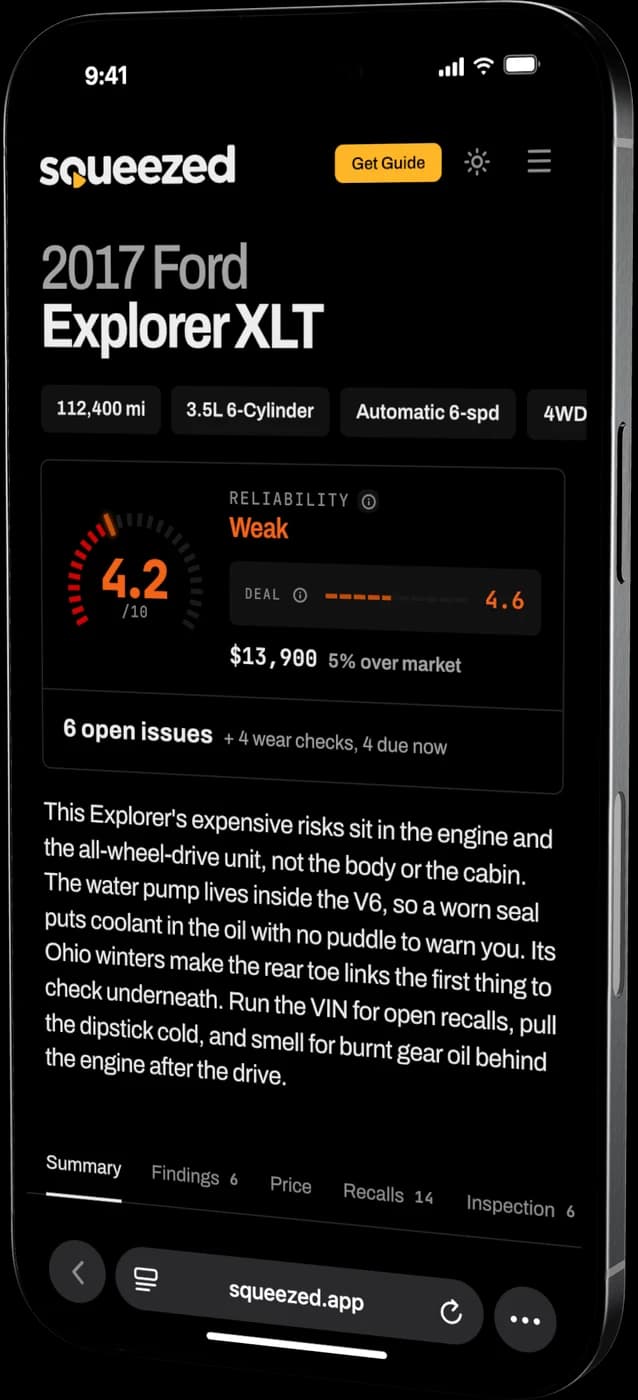
Search the car you’re looking at. In about a minute: known failure patterns, repair cost exposure, questions to ask the seller and an overall risk rating.
Use it before you book an inspection
Squeezed is a buyer guide based on public data and industry patterns, not a mechanical inspection. Always get a professional pre-purchase inspection before you buy.