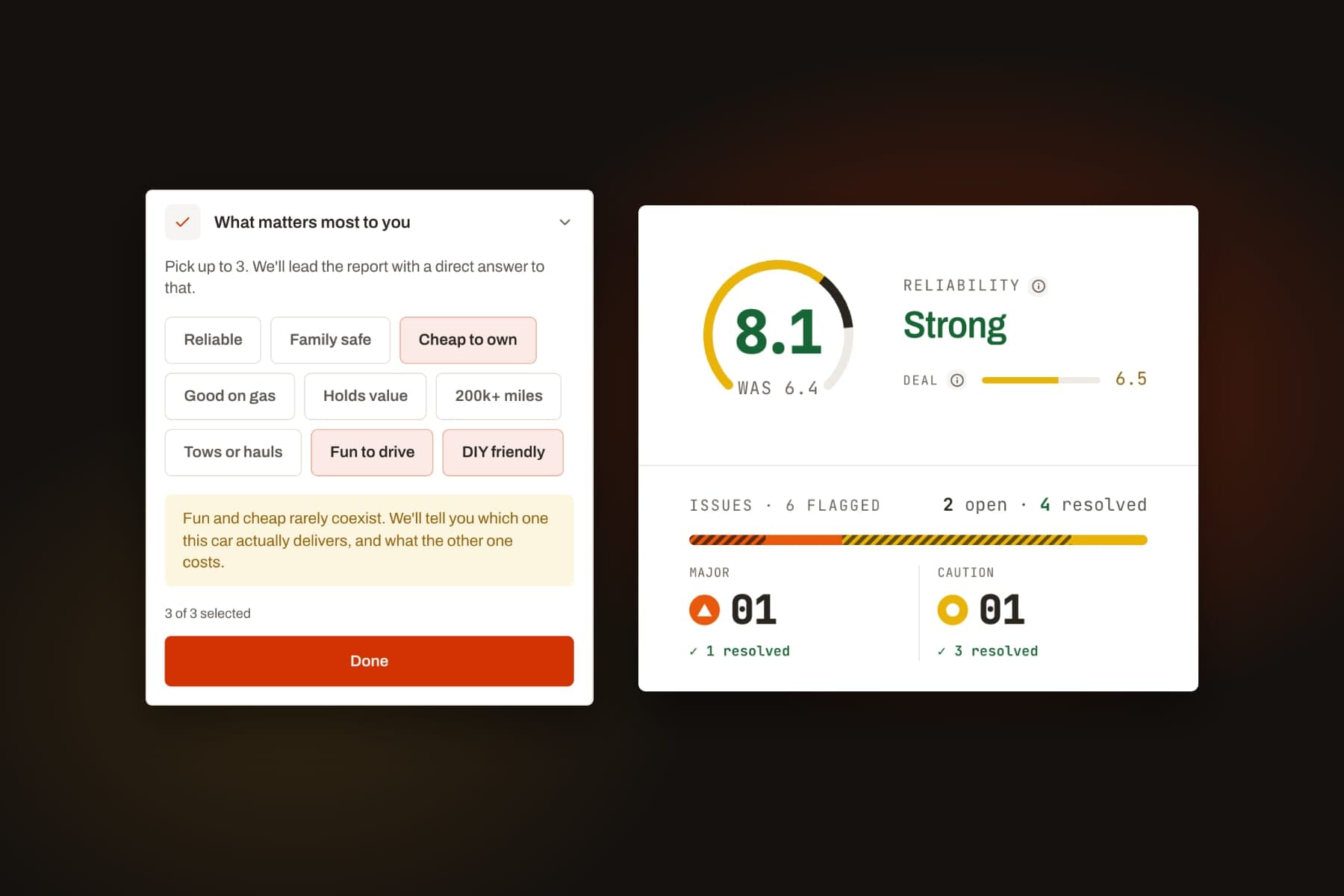
What's New in Squeezed: Reliability Outlook, Price Consensus, and a Smarter Buyer Guide
The Squeezed Buyer Guide now shows when problems tend to appear on a used car, what they typically cost, and whether the asking price is fair. Here is how the new Reliability Outlook, Price Consensus, and Budget Planner help you buy smarter.
 Mirko6 min read

On this page6 sections
The Squeezed Buyer Guide just got its biggest upgrade since launch. Your guide now shows not just what tends to go wrong with a model, but when those problems usually appear, what they typically cost, and whether the asking price looks fair, with the pricing cross checked by several AI models instead of one.
If you're researching a used car right now, here is what each part of the guide can tell you before you ever drive out to see one.
Reliability Outlook: see how risk climbs with the odometer
A list of known issues tells you what can go wrong. It doesn't tell you when. That gap matters, because a problem that typically shows up at 140,000 miles is a very different situation than one that tends to hit at 70,000.
The Reliability Outlook is a risk curve plotted against mileage. It maps the model's expected service life, the point where failure risk starts to climb, and the mileage band where it moves from caution to critical. The specific car's odometer reading is marked right on the curve, so you can see at a glance whether the car you're looking at sits in the calm stretch or the steep part.
What it tells you: the answer to the question every used car buyer asks in one form or another, "is this car early in its life or late?" A static issue list can't answer that. A trajectory can. The Reliability Outlook turns used car reliability from a yes or no label into something you can read against the miles on the clock.
Budget Planner: what a model tends to cost, and when
Knowing a model has a weak transmission is only half the picture. The other half is timing. The Budget Planner breaks likely costs into buckets: what to verify before you buy, what commonly comes up in the first year, and what tends to be further out. Each bucket carries a cost estimate and a severity tone, so a small near term item reads differently from a large one further down the road.
What it tells you: the cost of a used car isn't only the sticker. It's the sticker plus the maintenance that typically follows. The Budget Planner lays out those likely costs and their timing in one place, so you have the full picture in front of you before you talk numbers with the seller. It's information to plan around, not a prediction of what any single car will need.
Price Consensus: a fair value, cross checked by multiple models
Asking a single AI model for a car's market value is risky, because one model can confidently produce a number that's simply wrong. So your guide doesn't rely on one.
Price Consensus queries several AI models from different families and combines their estimates into a single fair private party value with a confidence range. When the models disagree by too much, the guide treats the estimate as lower confidence instead of pretending to a precision it doesn't have.
What it tells you: a fair price estimate you can lean on is the whole point of negotiating from data. Consensus across independent models is far harder to fool than any single estimate, and the variance check keeps the guide honest when a car is genuinely hard to value. The number you see is a market value estimate to inform your own negotiation, not a quote or an appraisal.
Inspection Checklist, built for the curb
The guide is meant to come with you when you go see the car. The inspection checklist works as a field tool: the model specific things to look at, listen for, and verify, in a format you can run through while standing next to the vehicle.
What it tells you: a detailed guide that stays on your laptop at home doesn't help you in the seller's driveway. The checklist makes the research portable to the moment it actually matters, the test drive and walkaround.
Where this fits in your used car research
None of this replaces a mechanic's pre purchase inspection. It comes before it. Squeezed is how you decide which cars are even worth a mechanic's time, so you can focus your inspection on the car that looks worth it rather than the ones that don't. The Reliability Outlook shows where a car tends to sit in its life, the Budget Planner lays out the likely cost and timing of upkeep, and Price Consensus gives you a fair market value estimate to negotiate against. Then you go look, with a checklist in hand.
Pull a Buyer Guide on the car you're considering. It takes about a minute and costs less than a tank of gas.
Frequently asked questions
What is the Reliability Outlook in a Squeezed Buyer Guide?
It's a risk curve that plots a model's expected failure risk against mileage. It marks where risk usually starts to climb and where it tends to become serious, with the specific car's odometer reading shown on the curve, so you can see whether that car is early or late in its typical service life.
How does Price Consensus estimate a fair price?
Price Consensus asks several AI models from different families to independently estimate the private party market value, then combines them into one figure with a confidence range. If the models disagree too much, the guide flags the estimate as lower confidence. It is a market value estimate to help you negotiate, not an appraisal or a quote.
Does the Budget Planner predict exactly what my car will cost?
No. It groups the likely costs for that model into timing buckets, what to verify now, what commonly appears in year one, and what tends to come later, with estimated figures. Every car is different, so treat it as a planning aid for typical ownership costs, not a guarantee for one specific vehicle.
Does a Squeezed Buyer Guide replace a mechanic's inspection?
No. The guide is the research step before a pre purchase inspection. It helps you decide which cars are worth booking a mechanic for. Use both: the guide to filter and prepare, and a hands on inspection to check the actual car.
How long does a Buyer Guide take?
About a minute. You enter the vehicle details and the guide assembles the Reliability Outlook, Budget Planner, Price Consensus, and inspection checklist for that specific make, model, and year.