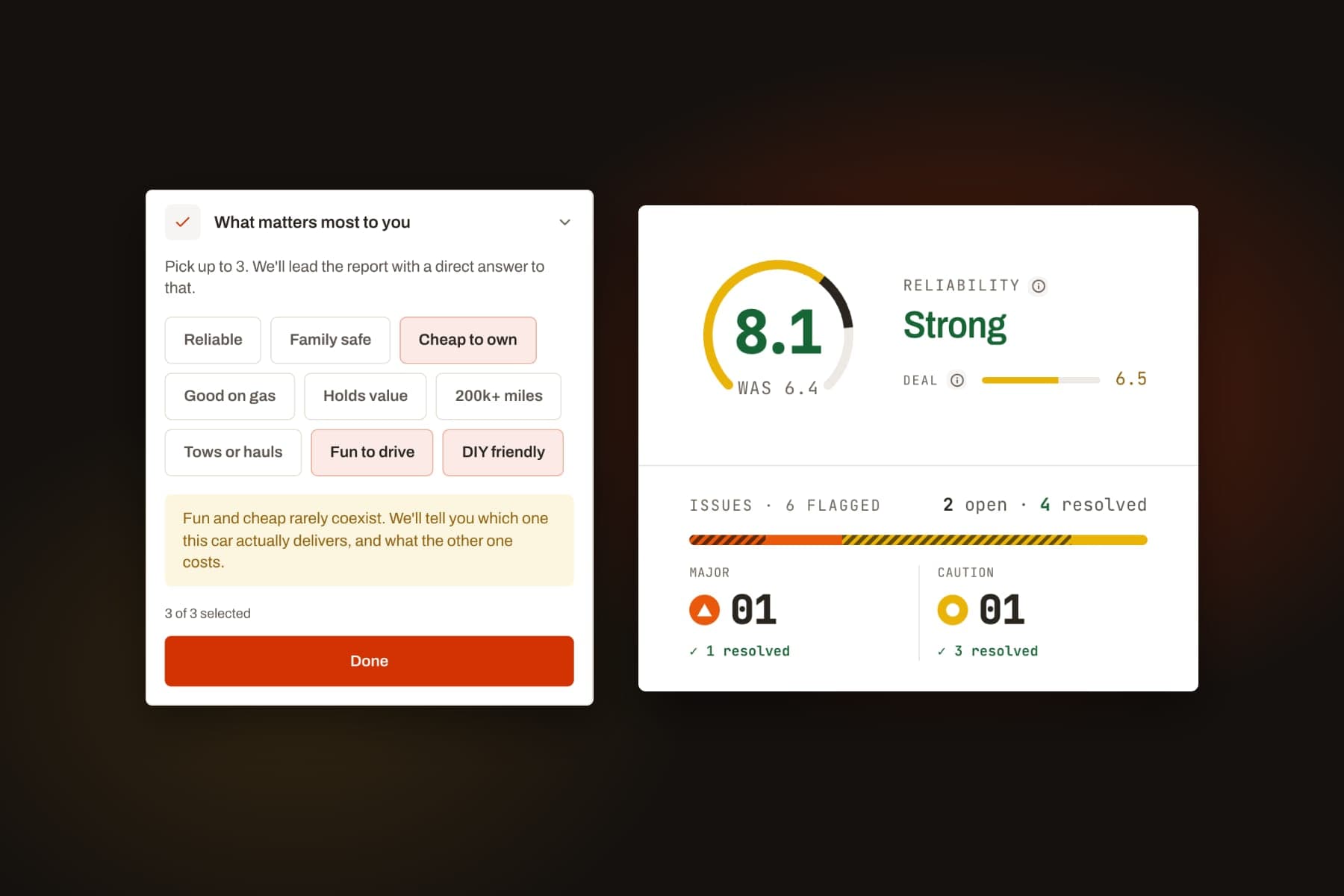
What's New in Squeezed: Official Safety Data, Scenario Planning, and Live Deal Scores
Your Squeezed Buyer Guide just got a major upgrade. It now pulls in official safety ratings and open recalls, lets you model the car's real condition, recalculates the deal score as you triage each issue, and shows a fair market price even when the listing hides one. Here is everything that is new and how it helps you buy with more confidence.
 Mirko6 min read

On this page8 sections
The Squeezed Buyer Guide has changed a lot in the past few weeks. The goal behind every update is the same: help you decide whether a specific used car is worth your time before you drive across town to see it.
This round of updates does three things. It brings in official safety and recall data so you are not taking the seller's word for it. It lets you model the car's actual condition instead of an average example. And it makes the deal score react in real time as you work through the findings, so the number always reflects the car in front of you. Here is the full tour.
See the whole guide at a glance
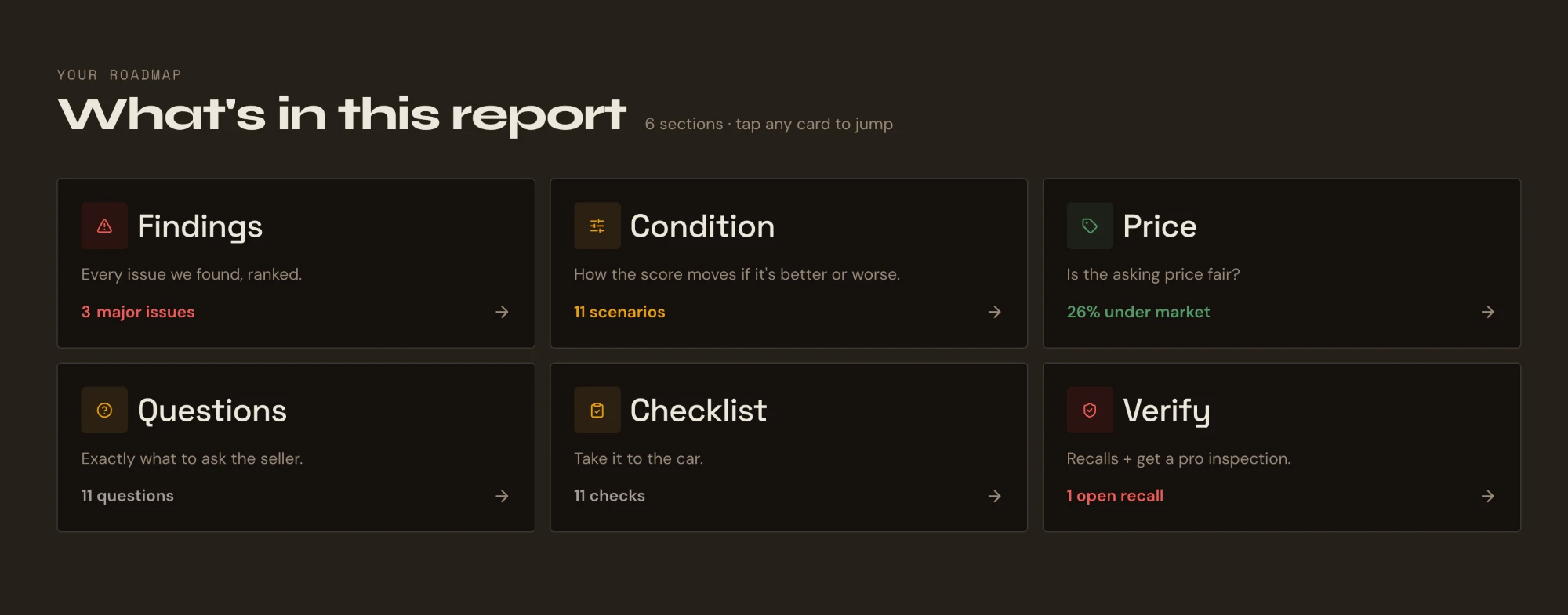
Every guide now opens with a band of overview cards: the deal verdict, the reliability picture, the count of issues by severity, and the price read, all in one glance. A sticky sub-navigation appears as you scroll so you can jump straight to the section you care about, whether that is the safety data, the findings, or the pricing.
The point is speed. You should be able to look at the top of the guide for a few seconds and know whether this car is a maybe or a hard no, then dig in only if it clears that first bar.
Plan around the car's real condition, not an average one
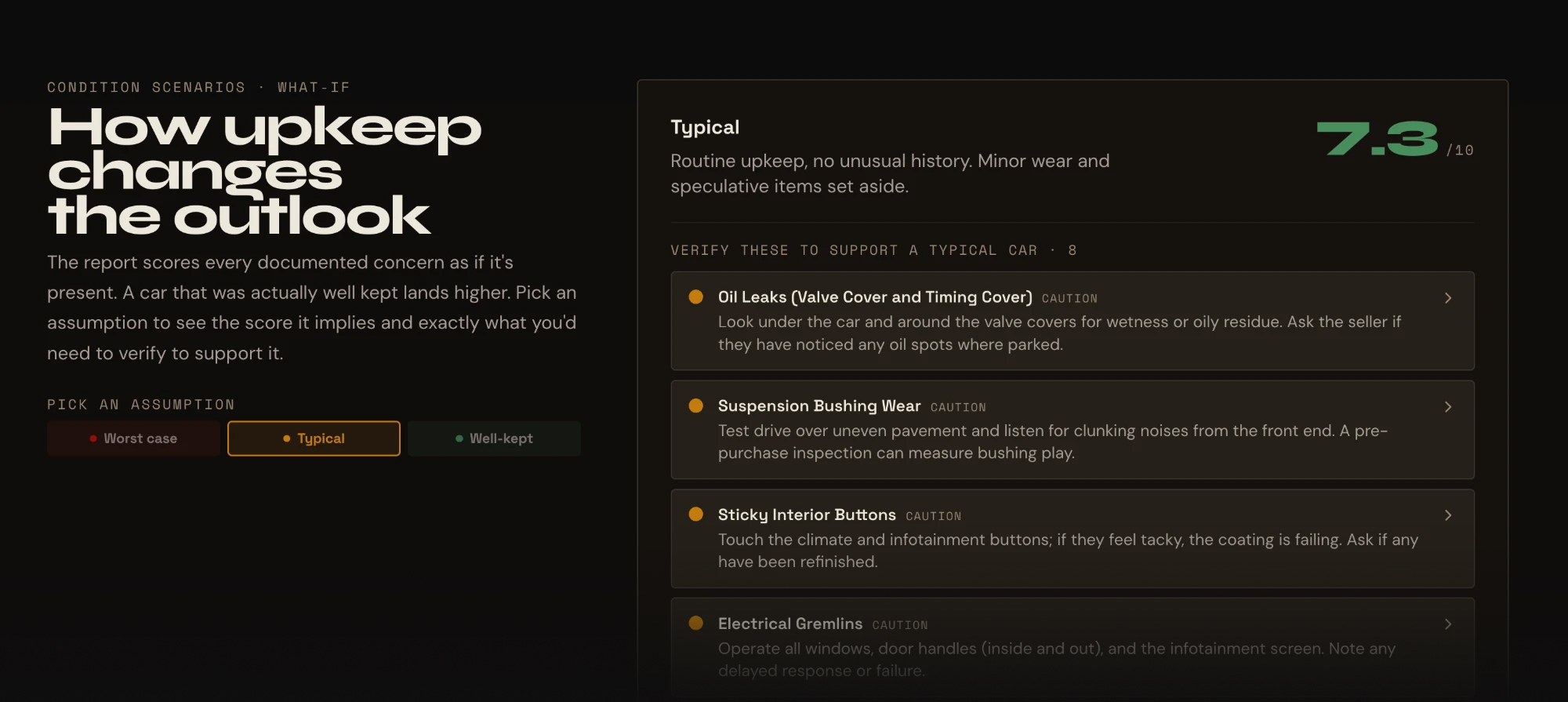
No two used cars of the same model are in the same shape. One has a folder of service records and fresh tires. Another is a higher-mileage example with a few deferred repairs. A single score cannot describe both.
The new condition lens lets you switch the guide between scenarios, the same way a pricing guide lets you pick Fair, Good, or Excellent condition. As you switch, the deal score and the findings recalculate to match. You can see what the car is worth and how risky it is under the assumption that fits the specific listing, rather than a generic middle case.
This is the difference between a static report and a planning tool. You are no longer reading one verdict. You are testing the car against the situation you are actually walking into.
Triage every issue, and watch the score respond
Each finding in the guide now has two actions: Resolve and Ignore. If the seller already replaced the part that a known issue refers to, mark it Resolved. If a flagged item does not apply to this car or does not bother you, mark it Ignored. Either way, the deal score recalculates on the spot.
That live recalculation is the part that matters. Instead of mentally discounting items in your head, you adjust the guide to the real car and the score keeps up. By the time you are done triaging, the number on screen is the honest picture of this exact vehicle in its current state.
Know exactly why your deal score is what it is
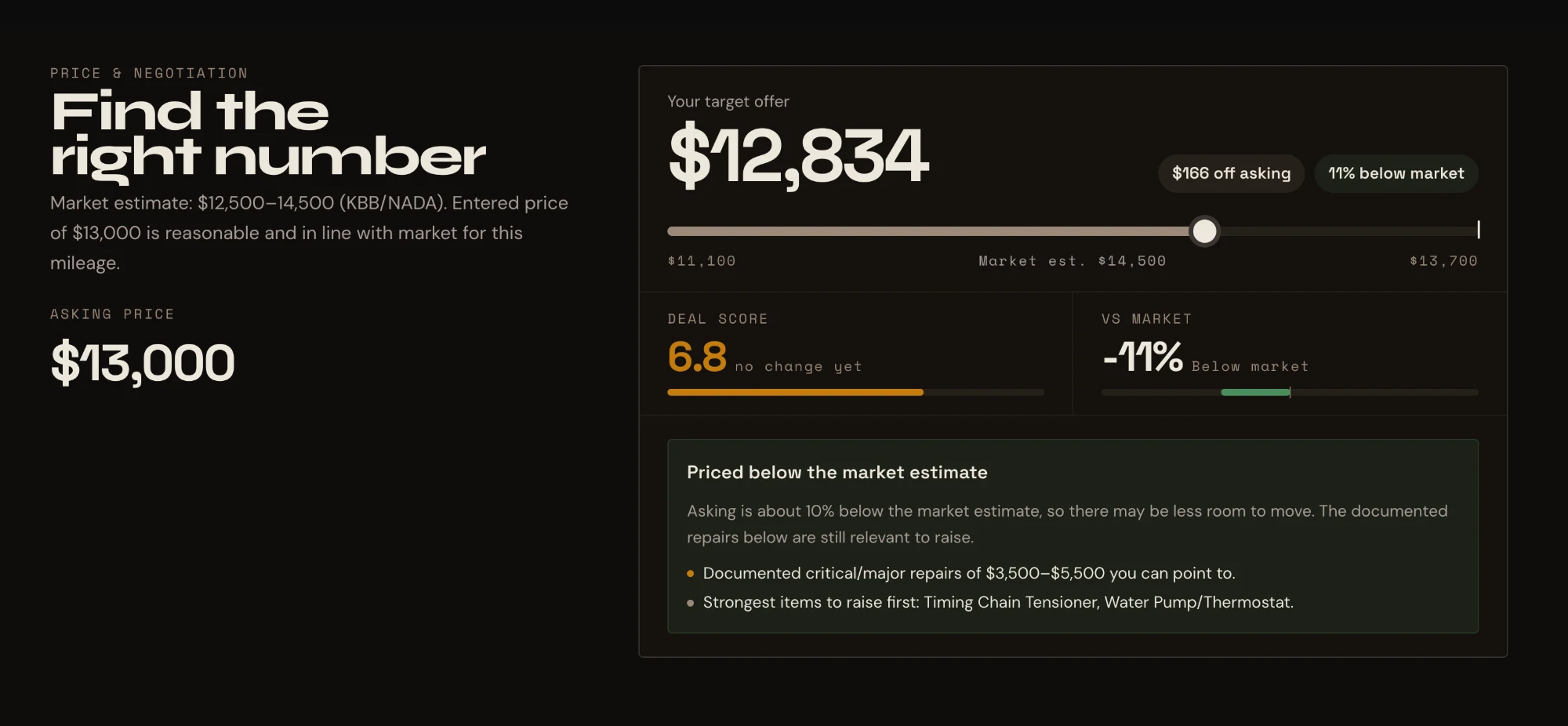
A score is only useful if you can see the reasoning behind it. The deal score now shows its work. Open the reasons and you get the specific factors moving the number up or down: the severity mix of known issues, how the asking price compares to the market, open recalls, and where the car sits on its reliability curve.
We also corrected how the score treats certain items. Major issues always count toward the score now, and open recalls are weighted as the safety signal they are rather than dragging the number around unpredictably. The result is a score you can defend, whether you are deciding for yourself or making the case to a co-signer or a partner.
Official safety ratings and open recalls, built right in
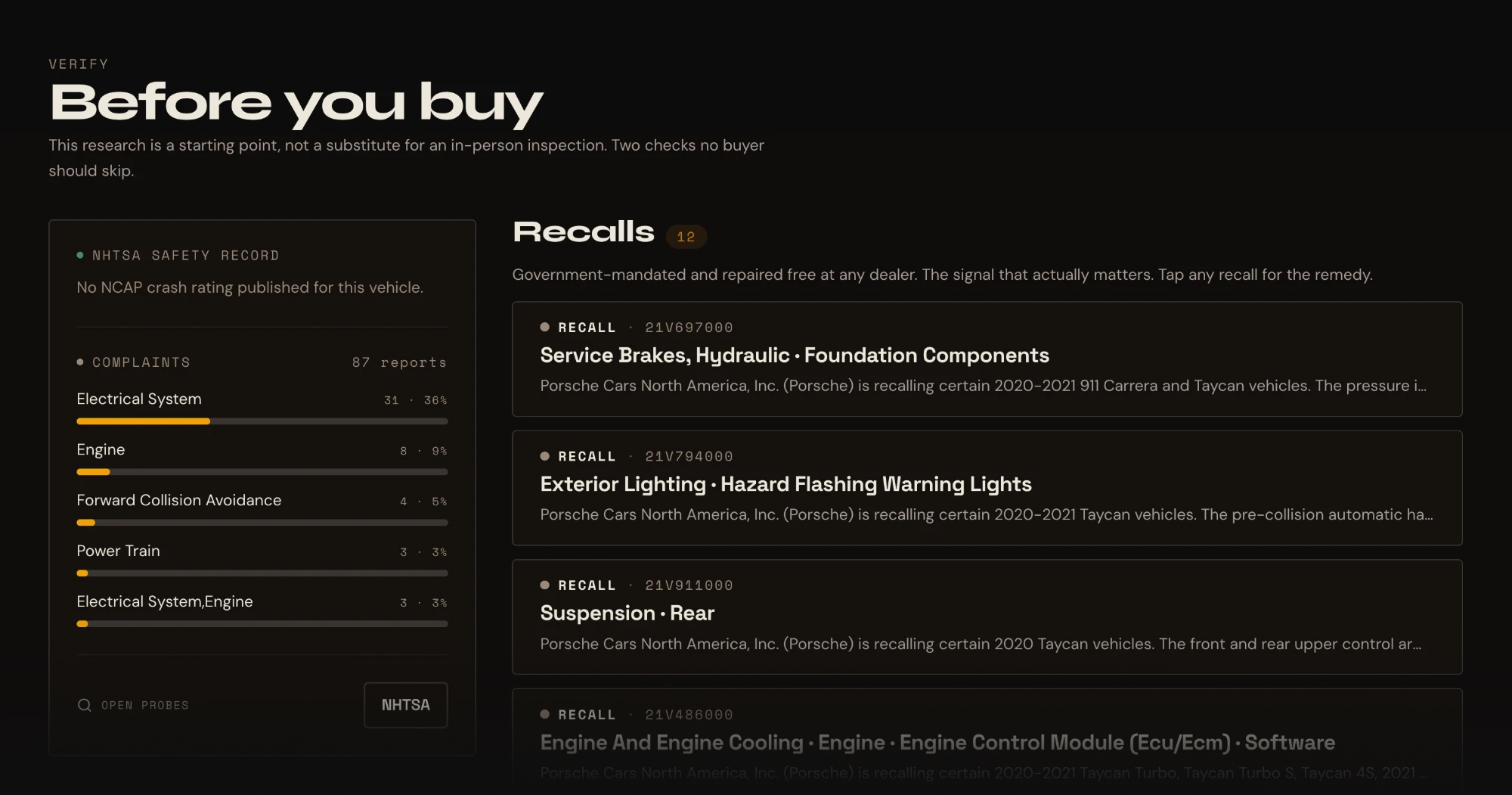
This is the biggest addition. Every guide now includes a dedicated safety panel powered by official NHTSA data. You get the government crash-test star ratings for the model, presented clearly instead of buried in a spec sheet.
Recalls come first, because an open recall is one of the few things that can turn a good deal into a non-starter. Each recall shows up as its own card, and opening it slides out a drawer with the full description of the defect and the remedy. You can see at a glance whether the model has a history of serious recalls, then ask the seller the one question that counts: has this specific car had the work done?
No more cross-checking a separate government site in another tab. The official safety record is part of the guide.
A fair price, even when the listing hides one
Plenty of listings leave the price off, or bury it behind a "contact us." That used to leave a hole in the guide. Now, when there is no asking price to check against, the guide shows a market estimate for the car instead, so you still walk in with a number in your head.
You know roughly what the car should cost before the seller says a word. That is exactly the position you want to negotiate from.
Share your guide, or save it as a PDF
A guide is more useful when you can take it with you. You can now share a guide with a quick set of share actions, handy when you are getting a second opinion from a friend or a mechanic. And you can print or save the whole guide as a PDF to bring to the seller, mark up during the test drive, or keep with your records.
The short version
Your Buyer Guide now tells you more, and tells it faster. It pulls in the official safety and recall record so you are working from facts, not the seller's story. It lets you model the car's real condition and triage each issue while the deal score keeps up live. And it gives you a fair price to anchor on, even when the listing tries to hide one.
All of it points at the same decision: is this specific car worth a closer look, or should you keep scrolling? Run your next listing through Squeezed and find out in about ninety seconds.