Fall 2026 Is Squeezing Used Car Buyers. Here's What's New
The average used car listing just hit its highest price since 2022, and repair prices are up 5.2% in a year. Here's what's new in Squeezed since August, and how each change helps you check a specific car before you buy it.
 Mirko10 min read
On this page14 sections
If your used car search feels harder this fall, the numbers agree with you. Listings are at their highest average price since 2022, the cheapest cars are selling fastest, and repairs cost more than they did a year ago. This is everything we've added to Squeezed since our August update.
The used car squeeze, by the numbers
| August 2026 | Change from a year ago |
|---|---|
| Average used listing price: $27,239 | Up 7%, highest since December 2022 |
| Used listings under $15,000: 15.1% of inventory | Down 25.9% |
| Like-for-like used car and truck prices | Down 2.3% |
| Vehicle maintenance and repair prices | Up 5.2%, against 3.4% for all prices |
Sources: Cox Automotive, Bureau of Labor Statistics.
The average is climbing while like-for-like prices fall because cheap cars are disappearing. At the current pace, the under-$15,000 inventory would sell through in 29 days, against 44 for the used market as a whole, and what's left is older and closer to its next big repair. That's why the cheapest used car is often the most expensive.
Repairs cost more, too. Tariffs on many imported auto parts took effect in May 2025, and CCC Intelligent Solutions, which tracks insurance repair estimates, saw parts prices rise most sharply in the months that followed. Our fall 2026 market breakdown has the rest.
Research that checks its own work
A guide no longer starts from one research model's opinion. Before anything is written, three or four models from different labs each list what tends to fail on your exact year, engine and trim. That's the "Polling independent research models" step on screen. If more than one of them flags a problem, your guide has to cover it or deliberately rule it out, like a fault the manufacturer fixed before your model year.
Findings follow stricter rules, too:
- Severity follows consequence, so routine maintenance like an oil change or a brake fluid flush is a caution and can't drag down a healthy car's score.
- Each finding's Sources tab names a specific owner community, document or repair reference instead of a generic "owner forums."
- Modifications like coilovers, headers or a tune are each assessed for that platform.
- The risk level weighs what repairs cost, not how many findings there are. A cooling system written up as three priced parts scores the same as one entry covering all three.
Tell it what you need the car to do
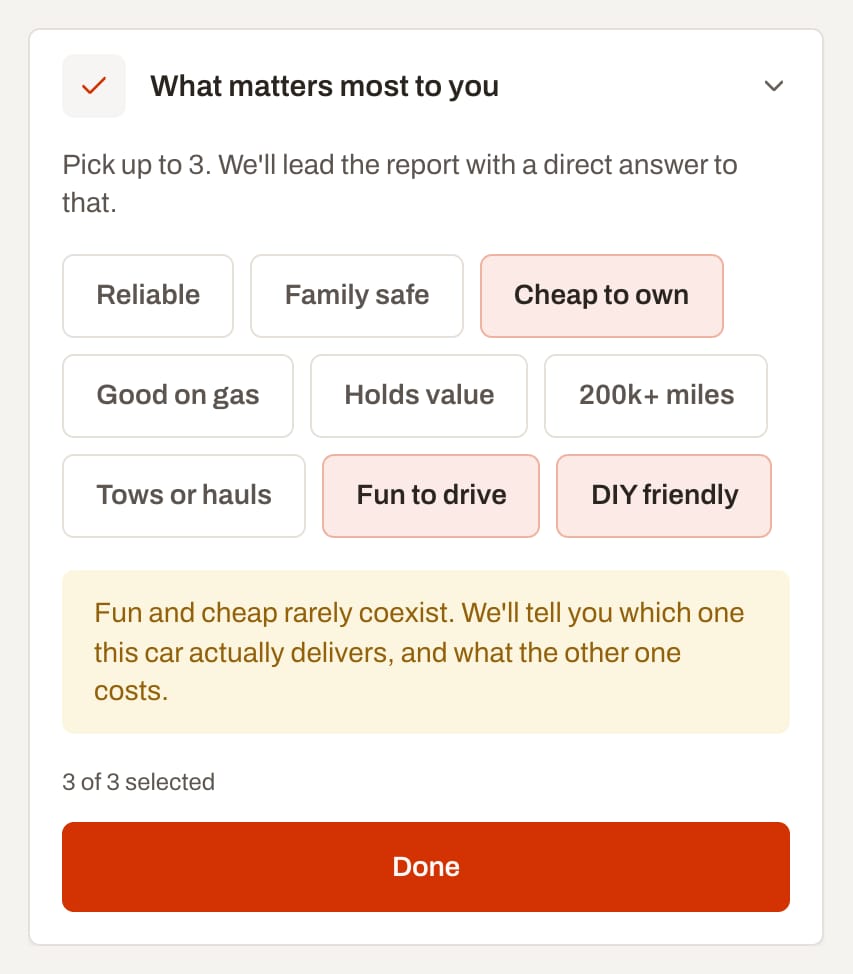
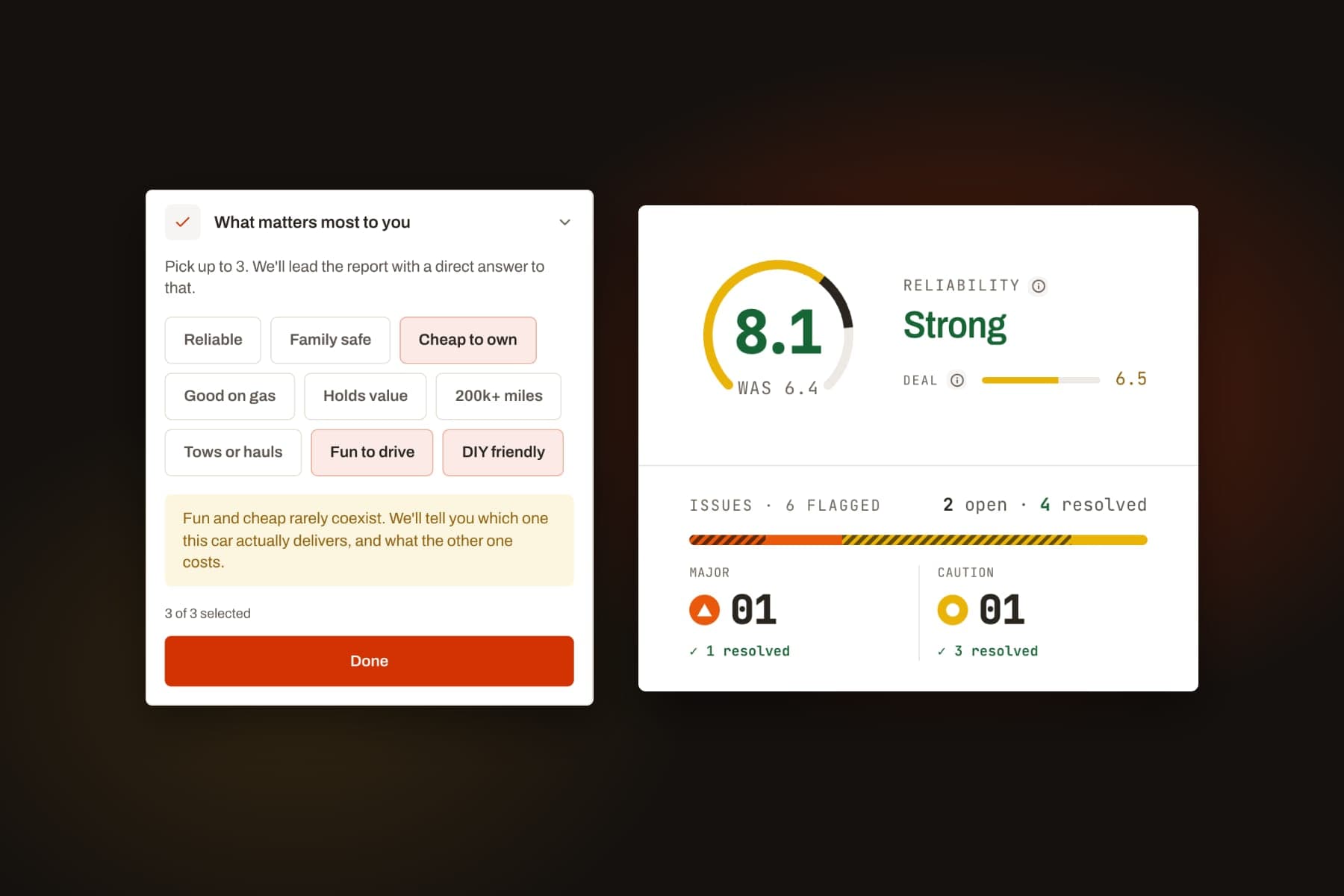
Guides now ask what matters to you. Pick up to three: Reliable, Family safe, Cheap to own, Good on gas, Holds value, 200k+ miles, Tows or hauls, Fun to drive, or DIY friendly.
Your Summary then opens with a straight answer. Pick Fun to drive and Tows or hauls on a 2020 Honda CR-V, and the guide tells you it's neither a driver's car nor a real tow vehicle, then what the CR-V is good at: cheap, dependable daily driving.
If two picks pull against each other, like Fun to drive and Cheap to own, you'll see a note while you choose, and the guide says which one this car delivers. Priorities change what the guide emphasizes, but they never hide a finding or lower its severity.
What a repair really costs on this car
Each finding has its own repair cost range, and the Price tab groups them by when you'd likely face them: Verify now, Possible year-one expense, and Watch later.
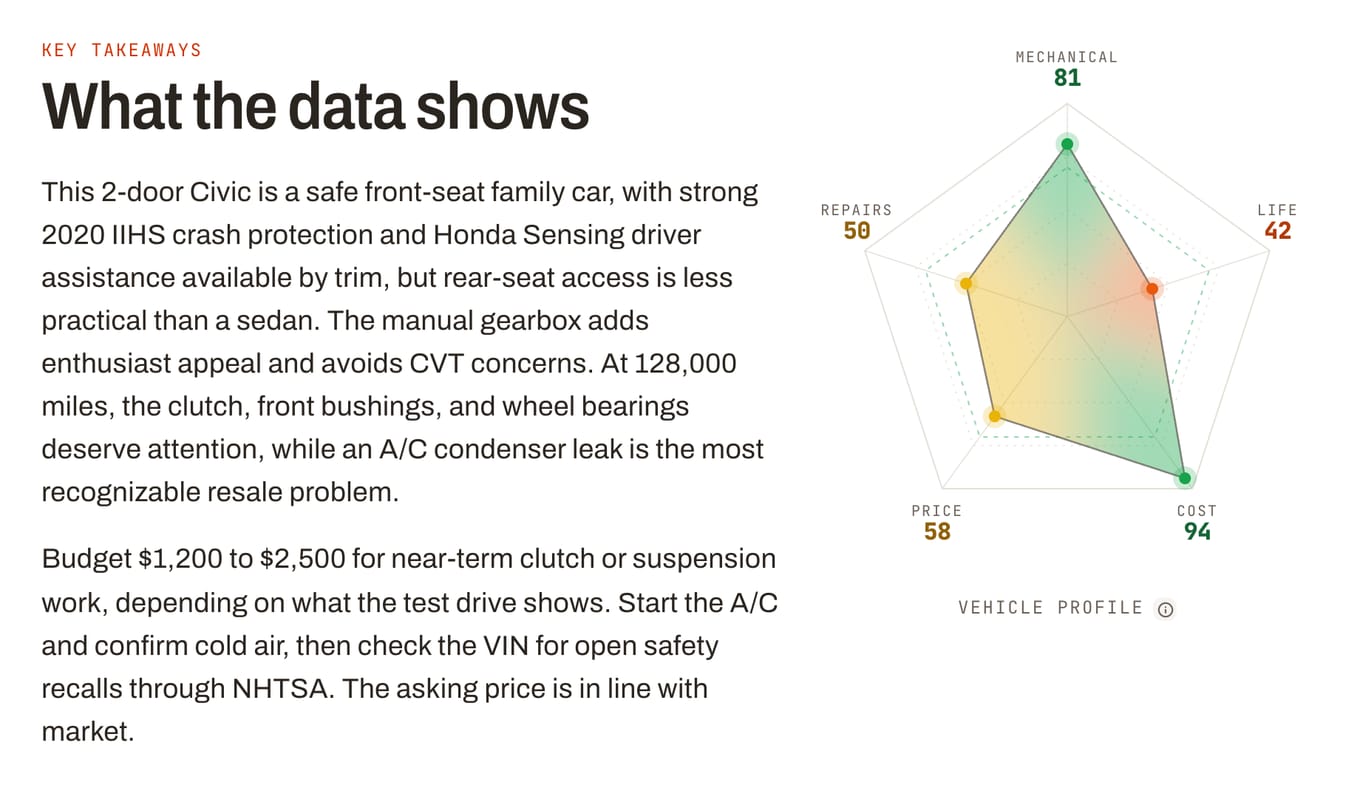
New guides with an asking price also get a vehicle profile on the Summary tab, scoring Mechanical health, Life left, Cost to keep, Price position and Repairability from 0 to 100. Higher is always better, so a dent in the shape is the weak spot. It redraws when you mark findings as checked or update the asking price.
Repairability is the score we'd look at first this year. Every likely repair is rated by who can realistically do it (you in your driveway, an independent shop, a specialist, or only the dealer) and weighted by how serious it is. Two cars with similar repair lists can land far apart if one is mostly weekend jobs and the other needs dealer software.
A score that moves when you check the car
A guide lists what's documented for the model. Standing next to the car is how you find out which of those apply to this one. Every finding now takes one of four answers: Looks fine, Confirmed a problem, Couldn't check, or Doesn't apply.
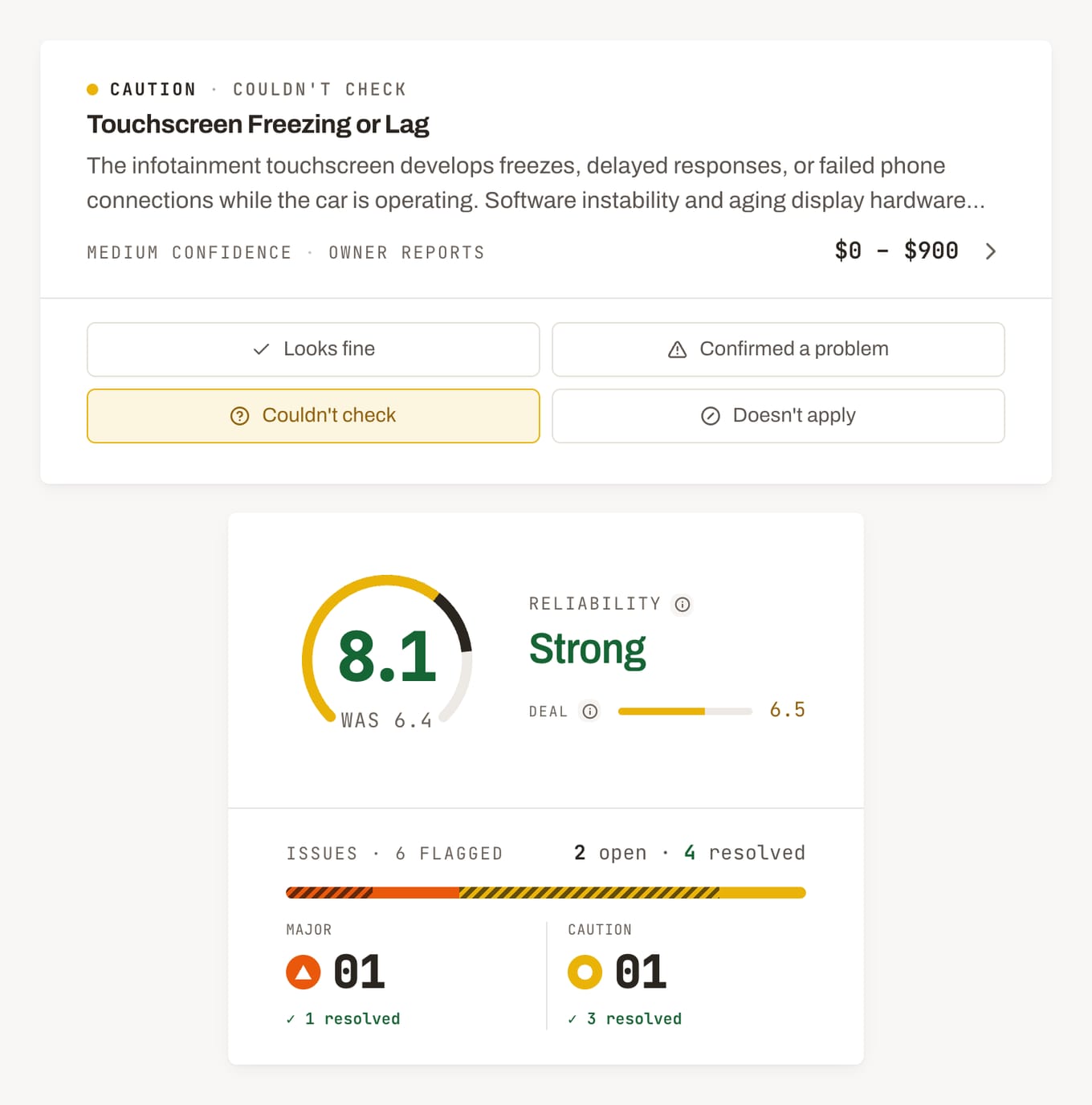
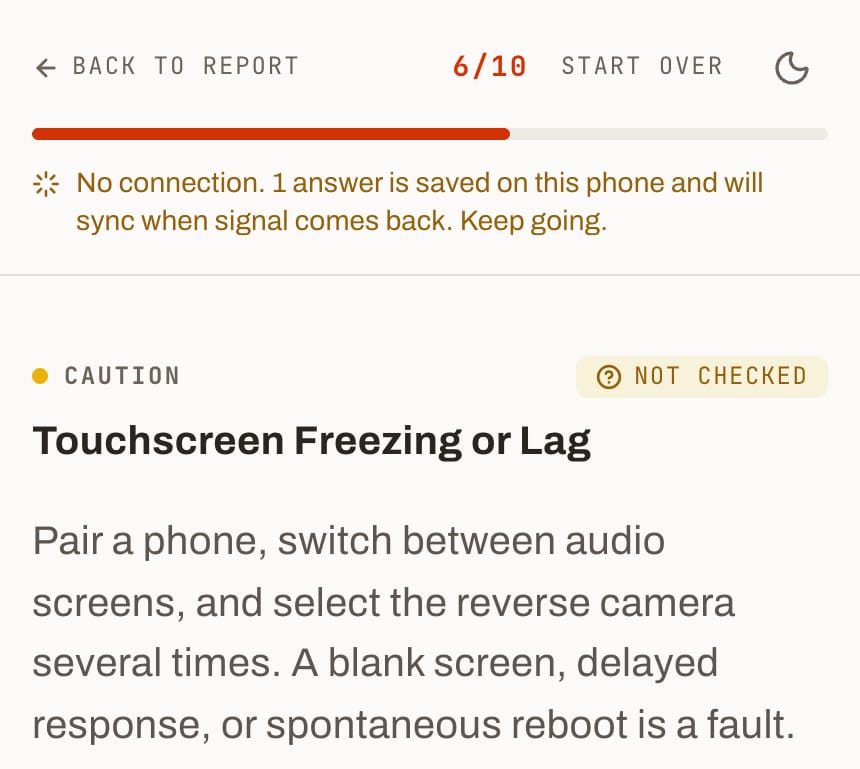
"Couldn't check" is the new one, and it still counts against the car. Only "Looks fine" or "Doesn't apply" takes a finding off the score. When your answers raise the reliability score, the dial shows where it started, like "was 6.4."
On a laptop, the Inspection tab shows a QR code that opens the in-person checklist on your phone. If you lose signal in an underground garage, your answers save on the phone and sync when you're back in range, and the checklist tells you so. When the research turns up only a few items, baseline checks fill out the walkthrough without changing the score.
Recall data that admits its gaps
NHTSA's recall database doesn't cover every car. For some low-volume makes it has almost nothing: its entire 2023 Ferrari recall catalog is one model. A car NHTSA never indexed used to show "no open recalls," which reads like good news. Now the Recalls tab says there's no NHTSA coverage for that model and tells you to check with the manufacturer or a dealer by VIN.
We also fixed recall matching for makes NHTSA files by trim. A 2015 BMW 328i used to show zero recalls because NHTSA lists it as "328I," not "3 Series." It now shows four.
Classic cars get their own path
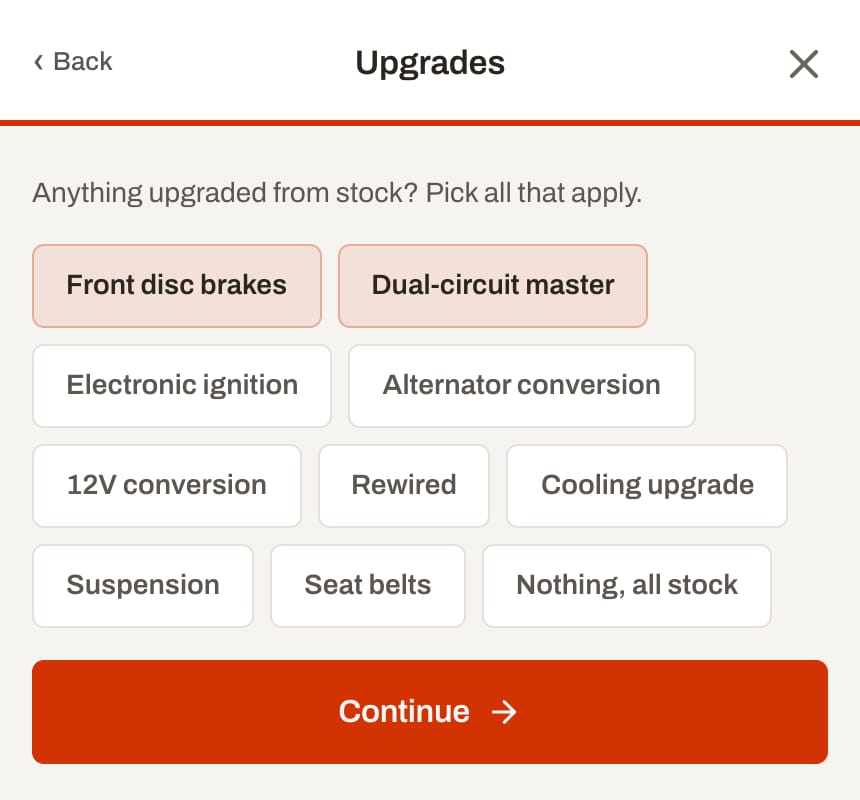
Squeezed now covers cars from 1965 through 1983. Tap "My car is older than 1984" under the year grid and the questions change to the ones that matter on a classic, like whether the engine is original, rebuilt or swapped, whether it runs, rust, upgrades and matching numbers. You can skip any of them, and type in a make or model we don't list.
Your answers change the research. A swapped engine gets mechanical findings for the engine in the car now, and value and originality findings for the factory one. Upgrades retire the warnings they fix, so front disc brakes and a dual-circuit master cylinder take the drum brake and single-circuit warnings off the list. A 1972 car won't be told to scan for trouble codes, and mileage is optional, since a five-digit odometer may have rolled over. Prices come from auction results, because book values don't track collector cars.
Paid guides: deeper research, photo inspection and compare
Free guides cover the core: failure patterns with repair costs, severity ratings, recalls and complaints, the in-person checklist, and a shareable link for your mechanic. A paid guide adds three things.
A deeper research pass. More passes over model-year specifics and rarer failure patterns, with a fourth research model in the cross-check. It takes a few minutes instead of about one.
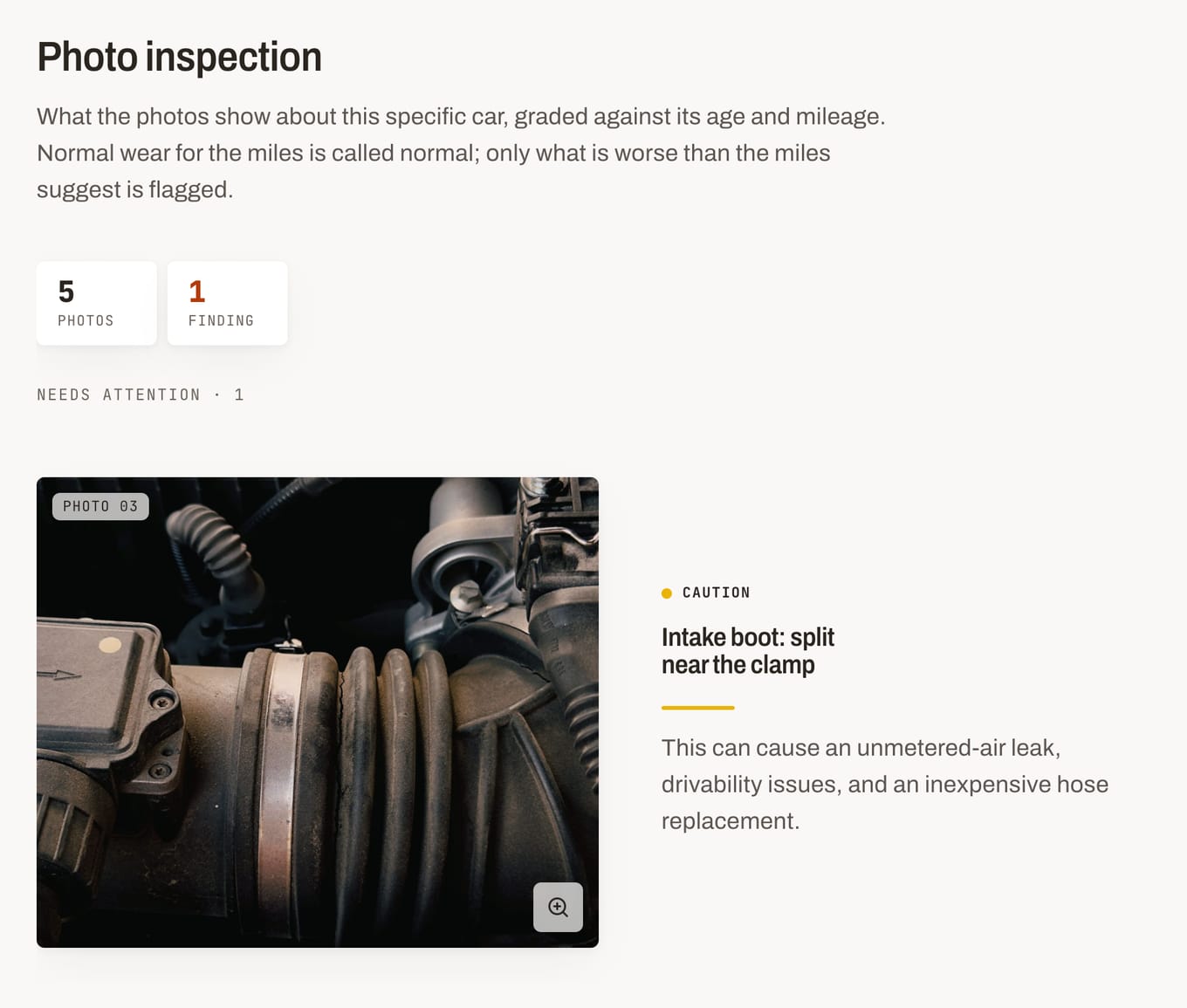
Photo inspection. Upload up to 10 photos of the car. Each one is checked to make sure it shows this car and not a stock image, then graded against what's normal for its age and mileage. Stone chips on an older car count as normal wear, while rust, leaks, torn covers, mismatched panels and bald tires get flagged. A dashboard warning light with the engine running counts as a live fault. What the photos show feeds into your findings.
Compare. Put your shortlist side by side, free guides included.
A single guide is $3.99, a 5-pack is $14.95 ($2.99 a guide), and a 10-pack is $19.90 ($1.99 a guide), so checking a whole shortlist costs less than $20. If you have both free and paid credits, you pick which kind each guide uses. The full breakdown is on the pricing page.
Smaller changes you'll notice
If a guide fails to generate, the credit comes back automatically, on every attempt. You can paste a VIN straight into the homepage search and it gets decoded for you. And you can now delete your account from your dashboard, which removes your guides and photos with it.
Coming soon: Squeezed for iPhone
We're finishing an iPhone app built on the same research and scoring as the website, with the in-person checklist designed for use at the car. It uses the same account, so the guides you've already run come with you.
New to Squeezed? Here's what every guide does
Enter a year, make, model and mileage, or paste a VIN, and in about a minute you get a Buyer Guide for that specific car:
- Known failure patterns
- Repair cost exposure
- Questions to ask the seller
- Overall risk rating
Each guide comes with the in-person checklist and a link for your mechanic that never expires, and your first guides are free during early access.
Squeezed is not a mechanical inspection. It's the step before one: run it on every car you're considering, cross off the ones with problems you don't want to take on, and spend the $150 to $300 pre-purchase inspection on the car that's left.
Before you message a seller
Run a guide on the car before you drive over. It takes about a minute, and you'll know what to ask the seller and what to check when you get there.
Findings reflect documented patterns for a year, make and model, not a guarantee for any individual vehicle. Always get a professional pre-purchase inspection before you buy.
Sources
- Cox Automotive, Used-Vehicle Prices Reach Highest Level Since 2022 as Inventory Tightens in August (September 11, 2026)
- U.S. Bureau of Labor Statistics, Consumer Price Index, August 2026, Table 2 (September 11, 2026)
- Federal Register, Adjusting Imports of Automobiles and Automobile Parts Into the United States (April 3, 2025)
- CCC Intelligent Solutions, Where the Repair Dollar Goes Now: A Primer on Tariffs, Parts, Freight, and Consumer Behavior (November 10, 2025)
FAQ
Is Squeezed free to use?
Your first Buyer Guides are free during early access, and free guides include failure patterns with repair costs, severity ratings, recalls and the in-person checklist. After that, a single guide is $3.99, a 5-pack is $14.95 and a 10-pack is $19.90.
What does a paid Squeezed guide add?
A deeper research pass over model-year specifics and rarer failure patterns, photo inspection of up to 10 photos of the car, and a side-by-side comparison of your shortlist.
Does Squeezed replace a pre-purchase inspection?
No. Squeezed researches what's documented for a car's year, make, model and mileage so you can decide which cars deserve a closer look. Always get a professional pre-purchase inspection on the car you plan to buy.
Do guides I already ran get the new features?
Some of them. The four finding answers, and the score that shows what your checks changed, work on any guide you own. Buyer priorities, the multi-model cross-check and the vehicle profile depend on how a guide is researched, so they appear on guides you run from now on.