Every 3rd Gen Explorer year compared
Owner complaints and recalls are from NHTSA. A year is marked to avoid when it has a critical problem the rest of the generation does not, or at least twice the generation's complaint rate once its age is taken into account. Years less than three years old are too new to judge. n/a means NHTSA has no data for that year.
Known problems on the 3rd Gen Explorer
- Critical · deal-breakers
- Major · costly soon
- Caution · keep an eye on
- OK · low concern
4.6L 2-valve Modular V8
- MajorAll years$600 – $1,000
Intake Manifold Failure
The plastic intake manifold cracks at its front coolant crossover and dumps coolant, which can overheat the engine.
- Major2002-2003$300 – $1,500
Spark Plug Blow-Out (1997 to 2003)
Early cylinder heads have only a few shallow threads holding each spark plug in soft aluminum, and a plug can strip out and shoot from the head, either while driving or after a plug change.
- CautionAll years$150 – $600
Ignition Coil Misfire
The coil-on-plug units fail with heat and age, and coolant, oil or water pooled in a deep plug well shorts them, causing a misfire on one cylinder.
4.6L 2-valve Modular V8 / 4.0L V6 (COLOGNE40-SOHC)
- MajorAll years$1,200 – $2,500
Timing Chain Guide Wear
On high-mileage cars, the plastic timing chain guides wear or crack, and the tensioners lose oil overnight so the chains slap on startup.
Ford 5R55W 5-speed automatic
- MajorAll years$1,000 – $3,500
Servo Bore Wear
This 5-speed automatic wears its servo pin bores, which lets the bands slip and shows up as flares, lost gears or a delayed reverse.
About the 3rd Gen Explorer
The 2002-2005 Ford Explorer is the third generation and represented the most significant engineering change in the model's history to that point, replacing the live rear axle with an independent rear suspension. Engines were the 4.0-liter SOHC V6 and the 4.6-liter Triton V8, paired with a five-speed automatic. Rear-wheel drive was standard with part-time and full-time four-wheel-drive systems available. A third-row seat became available for the first time, and the two-door body was spun off as the separate Explorer Sport Trac and Sport models.
The independent rear suspension improved ride quality and allowed a lower third-row floor, directly addressing the packaging limits of the previous generation. The body was also substantially stiffer. The fourth generation that arrived in 2006 kept this architecture and concentrated on refinement and durability improvements.
As a used buy, this generation is affordable but requires careful inspection. The SOHC V6 timing chain cassettes remain the defining mechanical concern, and the rear cassette in particular is expensive to service. Rear differential and independent rear suspension bushings wear on higher-mileage examples. Transmission durability on the five-speed automatic is mixed and service history matters. The 4.6-liter V8 avoids the timing chain issue and is generally the more durable choice in this generation.
Other Ford Explorer generations
Free Car Finder
Still deciding on the Ford Explorer?
Answer a few quick questions and see your top 3 used cars, with the years to shop.
Before you message the seller
Say goodbye to surprise repair bills.
Search the car you’re looking at. In about a minute: known failure patterns, repair cost exposure, questions to ask the seller and an overall risk rating.
Use it before you book an inspection
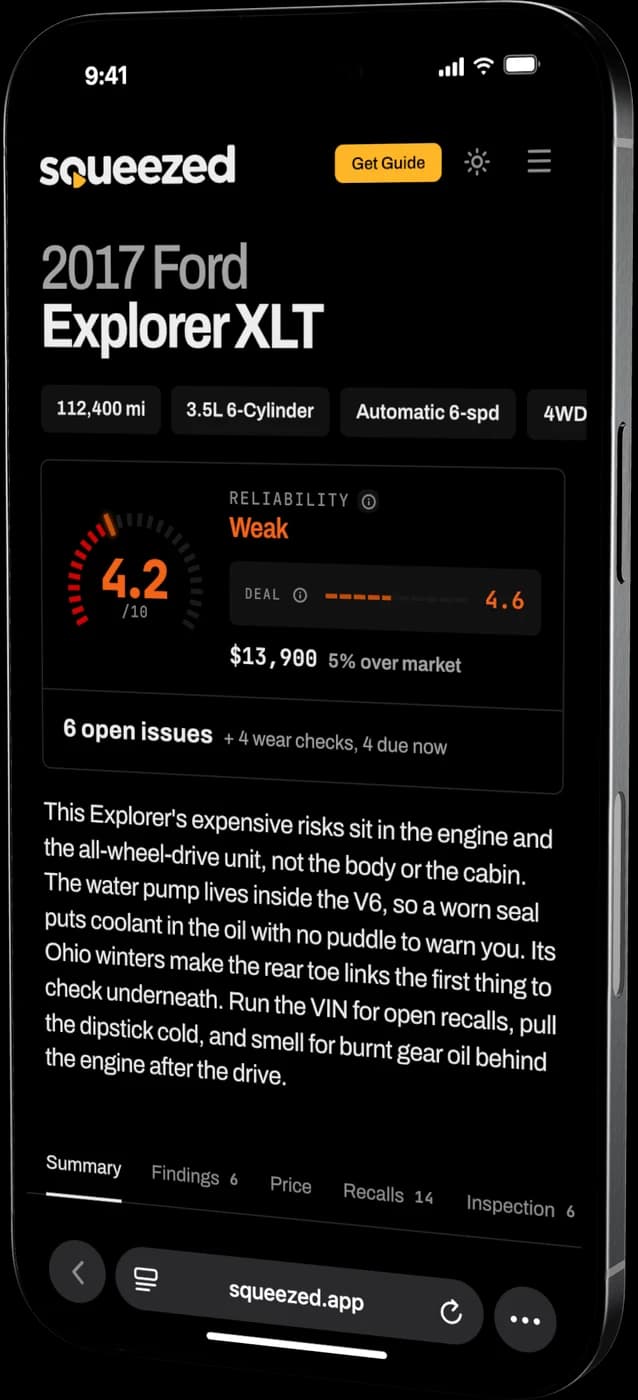
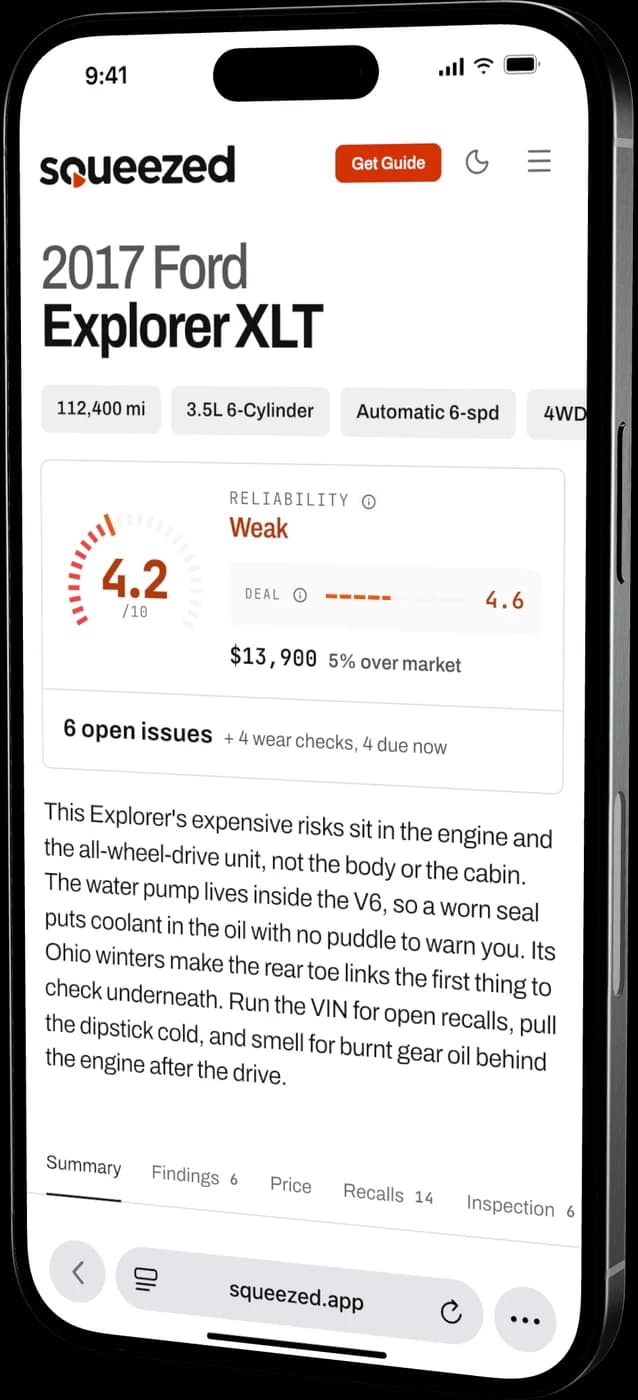
Squeezed is a buyer guide based on public data and industry patterns, not a mechanical inspection. Always get a professional pre-purchase inspection before you buy.