Every 4th Gen Explorer year compared
| Year | Verdict | Major problems | Complaints | Recalls |
|---|---|---|---|---|
| 2006 | n/a | 3 | n/a | n/a |
| 2007 | n/a | 3 | n/a | n/a |
| 2008 | n/a | 3 | n/a | n/a |
| 2009 | n/a | 3 | n/a | n/a |
| 2010 | n/a | 3 | n/a | n/a |
Owner complaints and recalls are from NHTSA. A year is marked to avoid when it has a critical problem the rest of the generation does not, or at least twice the generation's complaint rate once its age is taken into account. Years less than three years old are too new to judge. n/a means NHTSA has no data for that year.
Known problems on the 4th Gen Explorer
- Critical · deal-breakers
- Major · costly soon
- Caution · keep an eye on
- OK · low concern
4.6L V8 (MOD46-3V)
- MajorAll years$1,000 – $2,500
Cam Phaser and Lash Adjuster Noise
Worn variable cam timing phasers knock at hot idle or rattle for a few seconds at start-up, and worn lash adjusters tick on one side of the engine.
- CautionAll years$300 – $1,200
Spark Plugs Breaking on Removal
The original two-piece spark plugs seize in the cylinder head and often break when removed, leaving part of the plug behind.
4.0L V6 (COLOGNE40-SOHC)
- MajorAll years$1,500 – $4,000
Timing Chain Guide and Cassette Failure
Ford's 4.0L V6 has timing chain guides that wear and rattle, and the rear chain repair means pulling the engine.
Ford 5R55S 5-speed automatic
- MajorAll years$1,000 – $3,500
Servo Bore Wear
This 5-speed automatic wears its servo pin bores, which lets the bands slip and shows up as flares, lost gears or a delayed reverse.
About the 4th Gen Explorer
The 2006-2010 Ford Explorer is the fourth generation and the last to use a body-on-frame layout. It carried over the 4.0-liter SOHC V6 and the 4.6-liter Triton V8, the latter upgraded to a three-valve cylinder head paired with a six-speed automatic. Rear-wheel drive was standard with part-time and full-time four-wheel-drive systems available. Three rows of seating were standard on most trims, and a power-folding third row was offered.
This generation focused on refinement rather than reinvention, with a stiffer frame, improved sound insulation, and standard stability control with roll mitigation, which was a direct response to the scrutiny the model had received in the previous decade. Towing capability remained a strong point against the unibody crossovers that were beginning to take market share. The fifth generation that followed in 2011 abandoned the frame entirely.
For used buyers, this is generally regarded as the most durable of the frame-based Explorers, but the SOHC V6 timing chain cassette issue persists and should be assumed to be a future expense on any high-mileage V6. The three-valve 4.6-liter V8 is stronger but is part of the Ford modular family associated with spark plug breakage during removal, a known service complication rather than a failure. Rear air suspension on equipped models and rear differential service are the other items worth checking.
Other Ford Explorer generations
Free Car Finder
Still deciding on the Ford Explorer?
Answer a few quick questions and see your top 3 used cars, with the years to shop.
Before you message the seller
Say goodbye to surprise repair bills.
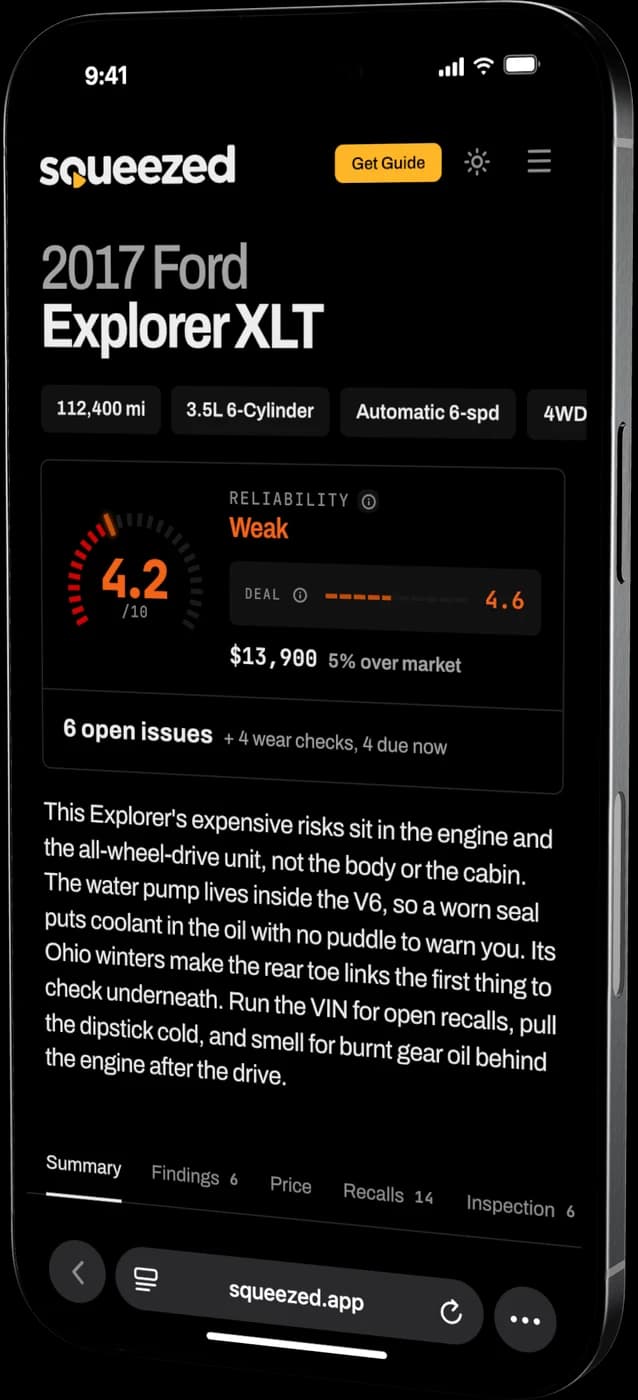
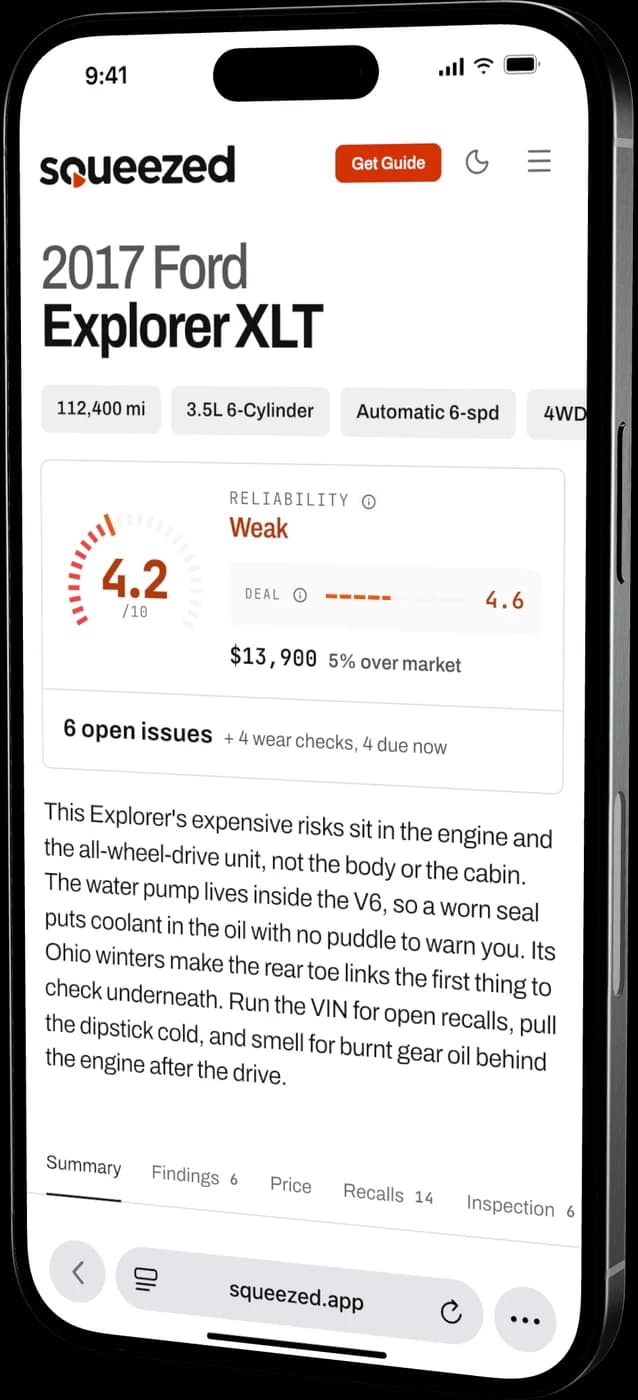
Search the car you’re looking at. In about a minute: known failure patterns, repair cost exposure, questions to ask the seller and an overall risk rating.
Use it before you book an inspection
Squeezed is a buyer guide based on public data and industry patterns, not a mechanical inspection. Always get a professional pre-purchase inspection before you buy.