Every 1st Gen Sequoia year compared
| Year | Verdict | Major problems | Complaints | Recalls |
|---|---|---|---|---|
| 2001 | n/a | 2 | n/a | n/a |
| 2002 | n/a | 2 | n/a | n/a |
| 2003 | n/a | 2 | n/a | n/a |
| 2004 | n/a | 2 | n/a | n/a |
| 2005 | n/a | 2 | n/a | n/a |
| 2006 | n/a | 2 | n/a | n/a |
| 2007 | n/a | 2 | n/a | n/a |
Owner complaints and recalls are from NHTSA. A year is marked to avoid when it has a critical problem the rest of the generation does not, or at least twice the generation's complaint rate once its age is taken into account. Years less than three years old are too new to judge. n/a means NHTSA has no data for that year.
Known problems on the 1st Gen Sequoia
- Critical · deal-breakers
- Major · costly soon
- Caution · keep an eye on
- OK · low concern
- MajorAll years$1,000 – $3,500
Secondary Air Injection Pump and Valve Failure
The cold-start air injection pump and valves on these trucks can fail and put the engine into reduced power mode.
- MajorAll years$700 – $1,500
Radiator Internal Cooler Leak
The transmission fluid cooler sits inside the radiator, and on an aging radiator it can leak internally so coolant and transmission fluid mix.
- CautionAll years$600 – $2,000
Exhaust Manifold Cracking
The exhaust manifolds on these Toyota V8s often crack and tick on a cold start.
- CautionAll years$300 – $700
Valve Cover Gasket Leaks
The valve cover gaskets on Toyota's 4.7L V8 harden and seep oil with age, mostly at the rear edges where it is hard to see.
- CautionAll years$600 – $1,200
Radiator & Heater Hose Failure
Radiators on these V8 trucks often seep at the plastic end tanks past 100,000 miles.
About the 1st Gen Sequoia
The 2001-2007 Toyota Sequoia is the first generation of Toyota's full-size body-on-frame SUV, derived from the first-generation Tundra pickup. It was powered by the 4.7-liter 2UZ-FE i-FORCE V8 paired with a four-speed and later five-speed automatic, with rear-wheel drive standard and four-wheel drive optional. The only body style was a four-door wagon with three rows of seating for up to eight.
The Sequoia was Toyota's first genuine competitor to the Chevrolet Tahoe and Ford Expedition, offering a significantly larger cabin than the 4Runner along with the same reputation for durability. It shared much of its front structure and drivetrain with the Tundra of the period. The second generation that followed in 2008 grew larger still and adopted an independent rear suspension.
For used buyers, a first-generation Sequoia is bought for the longevity of the 2UZ-FE V8, which regularly reaches very high mileage with routine maintenance. Frame corrosion is the central structural concern for this generation and was covered by a Toyota inspection program on affected trucks, making an underbody inspection non-negotiable on any example from a salted-road region. Lower ball joints were recalled, and vehicle stability control system faults are a common age-related complaint. Timing belt service is a scheduled item on this engine.
Other Toyota Sequoia generations
Free Car Finder
Still deciding on the Toyota Sequoia?
Answer a few quick questions and see your top 3 used cars, with the years to shop.
Before you message the seller
Say goodbye to surprise repair bills.
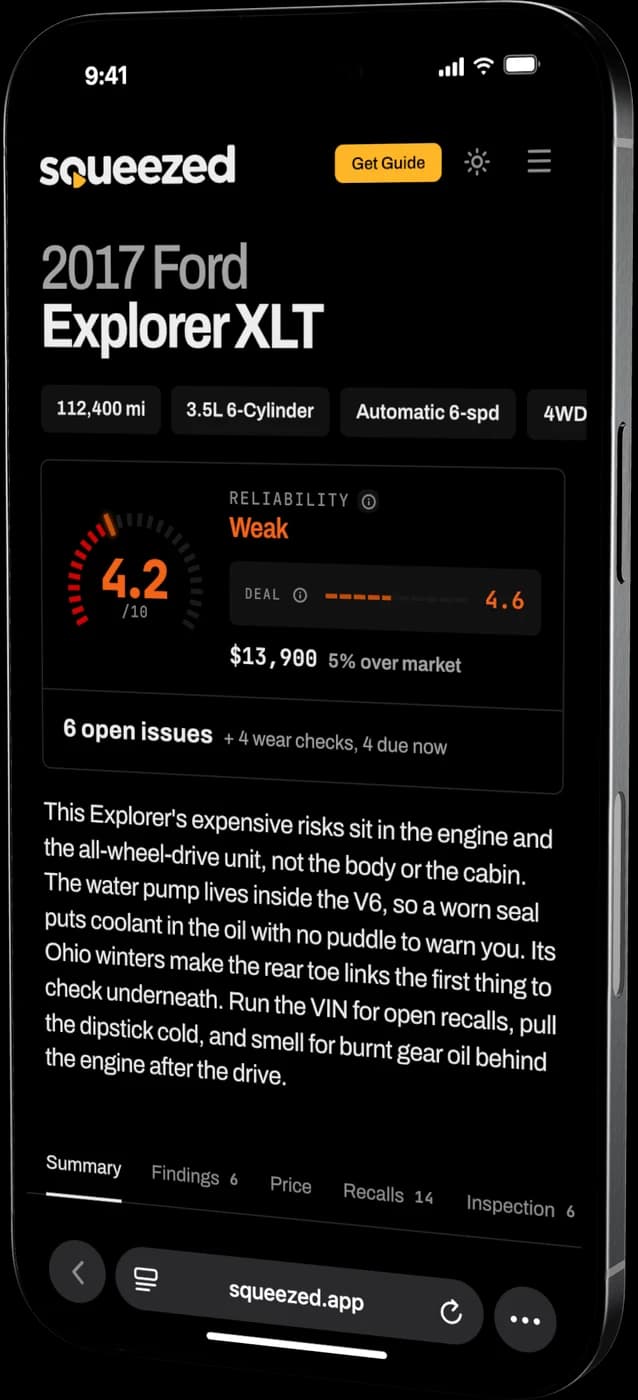
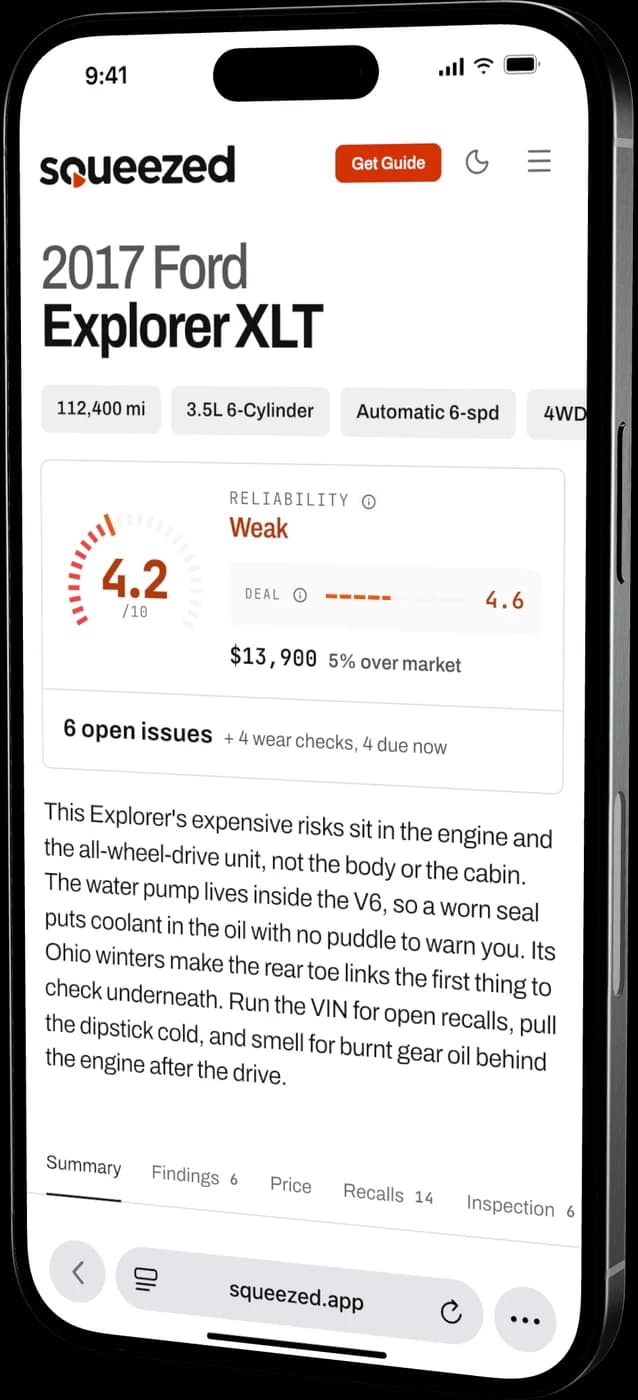
Search the car you’re looking at. In about a minute: known failure patterns, repair cost exposure, questions to ask the seller and an overall risk rating.
Use it before you book an inspection
Squeezed is a buyer guide based on public data and industry patterns, not a mechanical inspection. Always get a professional pre-purchase inspection before you buy.